

Peridynamics · Computational mechanics · AI-assisted CAE
I am a PhD researcher in Infrastructure Engineering at The University of Melbourne. My work combines computational mechanics, peridynamics, and AI/ML to study fracture, impact, and multiscale material behaviour, including concrete and composite systems.
I build research software that connects reusable material models with reproducible simulation and AI-assisted CAE workflows.
- The University of Melbourne — PhD researcher in Infrastructure Engineering, since December 2024.
- Tongji University — M.Eng. in Civil Engineering, 2021–2024.
- Southeast University — B.Eng. in Civil Engineering, 2017–2021.
- HKUST — Research Assistant, 2024: human–robot collaboration, digital twins, and deep reinforcement learning for robotic tool grasping.
- The University of Tokyo — Research Assistant / Visiting Student, 2022–2023: Python-based data collection and analysis for global flood-hazard mapping.
My technical work spans C++, Python, and Fortran, numerical solver development, FEM and peridynamics, surrogate modelling, and transfer learning.
Reuse compatible Fortran VUMAT-style material routines in a standalone C++ correspondence-peridynamics solver.
- Elastic, Johnson–Cook, and Neo-Hookean material examples.
- Particle demos covering tension, bending, and torsion.
- Documented interface conventions and reproducible numerical verification.
Explore the demos · Read the architecture
My contribution to CAE Agent Hub: an initial Peridigm workflow that connects context clarification, confirmed simulation specifications, solver execution, independent checks, and browser visualization through a shared CLI/MCP core.
- Two recorded demos: elastic verification and precracked tensile damage.
- Material-point playback, Damage/displacement switching, and actual response histories.
- Reusable Skills, configuration examples, and bilingual documentation.
Elastic demo · Damage and crack-advance demo · Merged contribution #34
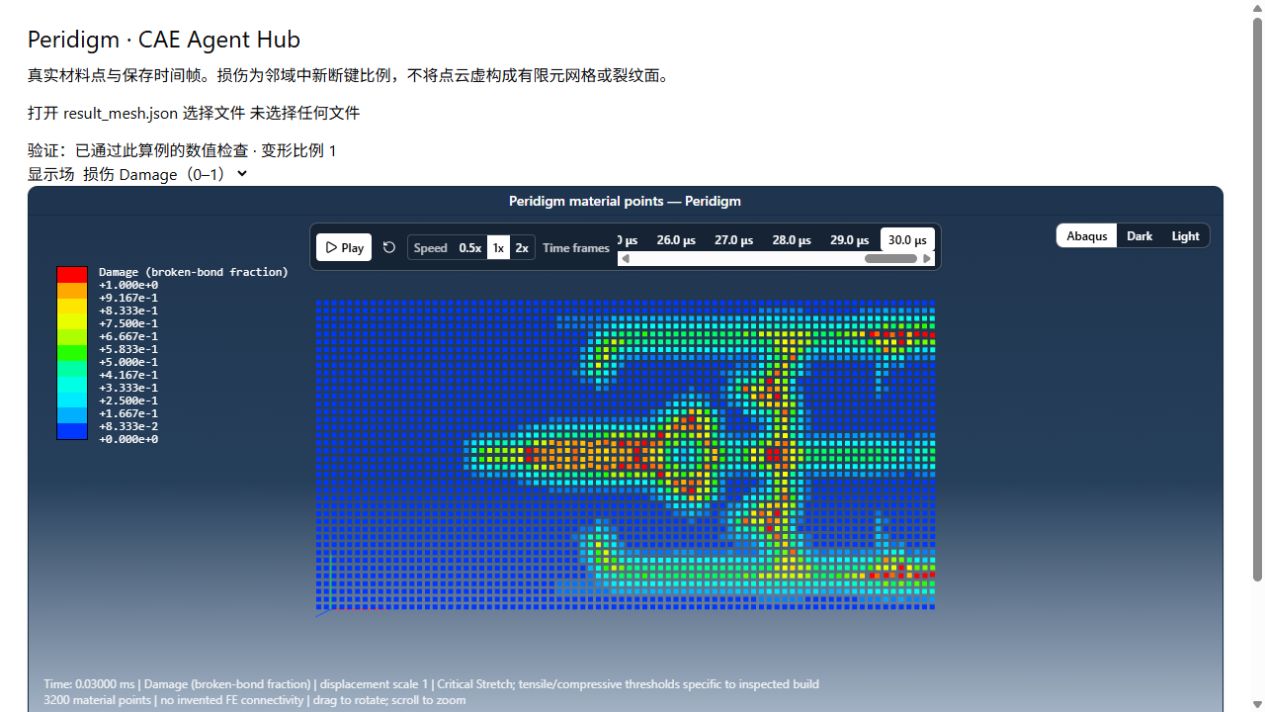
Recorded synthetic damage demonstration with numerical consistency checks; not an experimentally calibrated fracture prediction.
- Peridynamics, constitutive-model reuse, and fracture/impact simulation.
- AI agents and MCP interfaces for CAE workflows; data-driven surrogate models.
- Reproducible numerical checks, visualization, and research software documentation.
For questions about a project, please use its repository's Issues.