


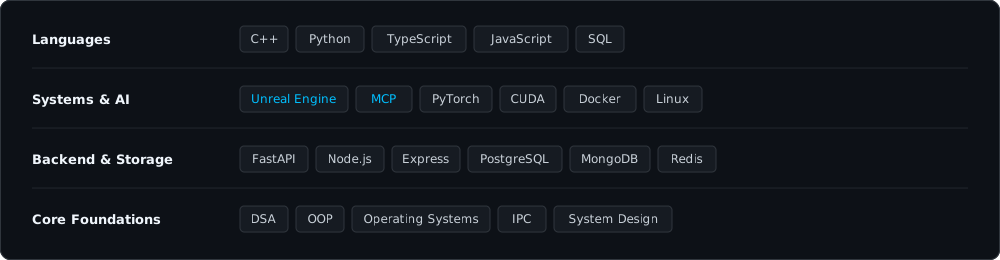
Computer science undergraduate focused on low-latency systems (C++), applied AI pipelines and distributed backend platforms. I co-build ScholarDive and author Unreal-MCP, a bridge that lets LLM agents drive Unreal Engine. I care about clean system boundaries, low-overhead inter-process communication and architecture that scales.
| Building | ScholarDive, an adaptive assessment platform with NLP-based grading |
| Shipped open source | Unreal-MCP, Mini GPT, AI Anime Challenge |
| Strongest at | C++ and Python, backend services, ML from first principles |
| Looking for | SDE internships, systems programming, high-impact applied AI roles |
 |
 |
 |
 |
ScholarDive: what I built and how it fits together
- Semantic scoring. Evaluation microservices on custom NLP pipelines that cut the manual, subjective part of grading.
- Submission backend. Asynchronous, low-latency services for ingesting and validating student submissions and reporting analytics.
- Feedback loop. Real-time telemetry so students see contextual feedback and performance tracking immediately.

Unreal-MCP: what I built and how it fits together
- Native engine RPCs. C++ bindings into Unreal Engine editor subsystems so an external reasoning model can control the viewport, actor transforms and scene assets.
- Low-latency IPC. Inter-process communication structured inside the native runtime for fast round-trip command execution.

Mini GPT: what I built
- First principles. Multi-head scaled dot-product attention, positional embeddings, layer normalization and residual layers, written without high-level abstraction frameworks.
- Training. Custom tokenization and GPU-accelerated batch training loops, with perplexity convergence benchmarks and KV-cache inference.
AI Anime Challenge: what I built
- Domain restoration. Engineered a video restoration and super-resolution pipeline targeting broadcast anime video on the Re-Anime600 benchmark (AINIME Challenge @ WACV 2027 Workshop).
- Temporal consistency. Implemented guided filtering and temporal consistency algorithms in PyTorch and CUDA to suppress compression artifacts and edge flickering.
| Clean system boundaries | Low-overhead IPC | Scalable by design |
|---|---|---|
| Small services with clear contracts, so scoring, ingestion and analytics can change independently. | Keep the hot path inside the process and the messages between processes small. | Cache in front of slow or rate-limited dependencies, and keep the write path asynchronous. |

Pull Shark · x2 Merged pull requests |

Quickdraw Closed issue / PR within 5m |

YOLO Merged PR without review |
