



OpenGJKSharp is a C# native implementation of the GJK (Gilbert-Johnson-Keerthi) algorithm, designed for efficient collision detection between convex polyhedra in 3D space. This project is inspired by the original openGJK (written in C) and reimagined for the .NET ecosystem.
Targets netstandard2.0, netstandard2.1, net8.0, and net10.0, so it can be used from .NET Framework 4.6.2+, .NET Core 2.0+, .NET 5+, Unity 2021.2+, and Mono.
You can install OpenGJKSharp via NuGet:
dotnet add package OpenGJKSharpOr using the Package Manager:
Install-Package OpenGJKSharpNote: Starting with 0.3.0, the entry-point class is named
OpenGjk(previouslyOpenGJKSharp, which collided with the namespace and could not be referenced without a namespace alias).
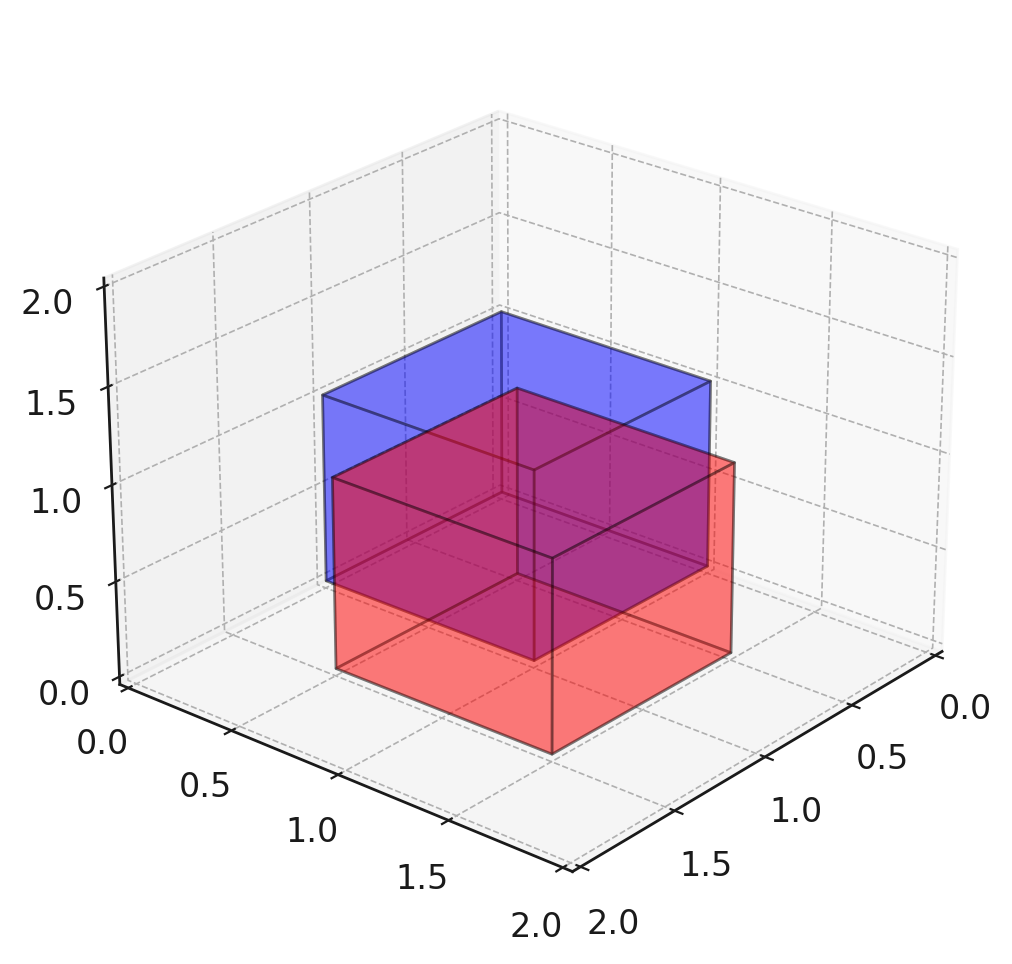
Here is an example of detecting a collision between two overlapping cubes:
using System.Numerics;
using OpenGJKSharp;

// Cube 1
var a = new Vector3[]
{
    new(0, 0, 0),
    new(1, 0, 0),
    new(0, 1, 0),
    new(1, 1, 0),
    new(0, 0, 1),
    new(1, 0, 1),
    new(0, 1, 1),
    new(1, 1, 1),
};

// Cube 2
var b = new Vector3[]
{
    new(0.5f, 0.5f, 0),
    new(1.5f, 0.5f, 0),
    new(0.5f, 1.5f, 0),
    new(1.5f, 1.5f, 0),
    new(0.5f, 0.5f, 1),
    new(1.5f, 0.5f, 1),
    new(0.5f, 1.5f, 1),
    new(1.5f, 1.5f, 1),
};

bool hasCollision = OpenGjk.HasCollision(a, b);

Console.WriteLine($"Collision detected: {hasCollision}"); // Outputs: true
The following image illustrates the collision between the two cubes:
ComputeCollisionInformation runs the GJK algorithm and, when a collision is detected,
the EPA (Expanding Polytope Algorithm) to compute the penetration depth and contact normal:
double distance = OpenGjk.ComputeCollisionInformation(a, b, out Vector3 contactNormal);

if (distance < 0)
{
    // Colliding: -distance is the penetration depth, and contactNormal is a unit vector
    // pointing from the first body toward the second - move b along it (or a against it)
    // by the depth to separate them.
    Console.WriteLine($"Penetration depth: {-distance}, normal: {contactNormal}");
}
else
{
    // Separated: distance is the minimum distance between the two bodies
    Console.WriteLine($"Distance: {distance}");
}
For depenetration, TryGetPenetration reports the same result without a sign convention to
get backwards - the depth is always positive and the normal always points from the first body
toward the second:
if (OpenGjk.TryGetPenetration(body, ground, out double depth, out Vector3 normal))
{
    position -= normal * (float)depth;   // move the first body out of the second
}
For exactly concentric bodies every direction is a valid minimum translation, so the returned normal direction is arbitrary (still unit length).
The depth is exact for polyhedra. Curved shapes (spheres, capsules, and custom support mappings) cannot be resolved exactly by a finite polytope, so their depth is reported as a slight overestimate - within about 0.3% for spheres, even when one body is fully inside the other - rather than an underestimate, so pushing the bodies apart by it always separates them.
ComputeMinimumDistance returns the minimum distance between two bodies
(0 when they collide) and can also report the closest point on each body:
double distance = OpenGjk.ComputeMinimumDistance(a, b, out Vector3 closestA, out Vector3 closestB);

Console.WriteLine($"Distance: {distance}");
Console.WriteLine($"Closest points: {closestA} <-> {closestB}");
The closest points are only meaningful while the bodies are separated, where they lie on
the respective surfaces. Once the bodies overlap there is no closest pair: the distance is
0 and both witness points collapse onto a common point inside the intersection, which is
not on either surface. Use ComputeCollisionInformation for that case.
HasCollision and ComputeMinimumDistance also accept Vector2[] polygons
(treated as flat shapes on the z = 0 plane).
Vector3 is single precision, so vertex coordinates are quantized on input - at a
coordinate of 1e6 the spacing of float is about 6e-2, and smaller gaps are lost.
Internal math always runs in double precision, and every query also accepts coordinates
as a ReadOnlySpan<double> of consecutive (x, y, z) triples when the input itself needs
that range:
double[] a = [1e6, 0, 0];
double[] b = [1e6 + 1e-3, 0, 0];

double distance = OpenGjk.ComputeMinimumDistance(a, b);   // 0.001, not 0

Span<double> normal = stackalloc double[3];
double info = OpenGjk.ComputeCollisionInformation(a, b, normal);
These overloads replace the legacy CsFunction (the obsolete openGJK C interface,
which took a [3, n] array); they are the same algorithm with a fuller result set.
Every query needs working buffers (simplex, support points, EPA polytope). The overloads
shown above allocate them per call, which is fine occasionally but becomes steady garbage
in a physics loop. Pass a GjkWorkspace to reuse the buffers instead - after the first few
queries have grown them, further queries of the same kind allocate nothing:
var workspace = new GjkWorkspace();

foreach (var (a, b) in pairs)
{
    double distance = OpenGjk.ComputeMinimumDistance(a, b, workspace);
    double info = OpenGjk.ComputeCollisionInformation(a, b, workspace, out Vector3 normal);
}
Every HasCollision, ComputeMinimumDistance, and ComputeCollisionInformation overload
has a workspace counterpart, for vertex arrays, 2D polygons, and ISupportMappable shapes
alike. A workspace holds no result state, so it can be reused as soon as a query returns.
It is not thread-safe: use one workspace per thread.
GJK is a support-function-based algorithm, so shapes like spheres and capsules can be
handled exactly - without tessellation - through the ISupportMappable interface.
Built-in shapes live in OpenGJKSharp.Shapes:
using OpenGJKSharp;
using OpenGJKSharp.Shapes;
using System.Numerics;

var sphere = new Sphere(new Vector3(0, 0, 0), radius: 1f);
var box = new Box(new Vector3(3, 0, 0), halfExtents: new Vector3(1, 1, 1));

bool hit = OpenGjk.HasCollision(sphere, box);
double distance = OpenGjk.ComputeMinimumDistance(sphere, box, out Vector3 onSphere, out Vector3 onBox);
double info = OpenGjk.ComputeCollisionInformation(sphere, box, out Vector3 contactNormal);Sphere, Capsule, Box (oriented, via a Quaternion), and ConvexHull are provided.
TransformedShape places any of them - or your own shape - at a pose, so a shape can be
defined once in local space and moved without rebuilding it. It is the only mutable shape:
SetPose updates the pose in place, which keeps a physics loop free of per-frame rebuilds:
var hull = new ConvexHull(localPoints);   // built once, in local space
var body = new TransformedShape(hull);
var workspace = new GjkWorkspace();

foreach (var frame in frames)
{
    body.SetPose(frame.Rotation, frame.Position);
    double distance = OpenGjk.ComputeMinimumDistance(body, ground, workspace);
}
You can plug in any custom convex shape by implementing the interface:
public sealed class Point : ISupportMappable
{
    private readonly Vector3 _position;

    public Point(Vector3 position) => _position = position;

    // Furthest point of the shape in the given direction (world space).
    public Vector3 GetSupportPoint(Vector3 direction) => _position;

    // An interior point, used as the initial guess for GJK.
    public Vector3 GetCenter() => _position;
}Shapes defined by a thickness parameter require it to be positive: Sphere and Capsule
reject a zero or negative radius, and Box rejects a zero or negative half extent, since
those are almost always a bug rather than an intent. A Capsule whose endpoints coincide is
not one of those cases - it is exactly a sphere and is handled as such.
Zero-thickness geometry is supported, through the shapes that take explicit points:
ConvexHull accepts a single point, two points (a segment), or coplanar points (a flat
polygon), and a custom ISupportMappable may describe any convex set. All of them, including
two coincident points, are queried without special cases.
Implementations must describe a convex shape, and GetSupportPoint must be exact for
the shape - GJK/EPA accuracy depends on it. Note that the public interface uses
single-precision Vector3, so support points are float-quantized on input (the
vertex-array API has the same input quantization); internal math runs in double
precision.
OpenGJKSharp is licensed under GPL-3.0, following the upstream openGJK project. Note that GPL-3.0 has copyleft requirements — if you plan to use this library in closed-source or commercial software, please review the license terms carefully.