Schema-grounded Multi-task Iterative Tool Honing
Zhi Rui Tam1,2, Chieh-Yen Lin1, Yun-Nung (Vivian) Chen2, Shao-Hua Sun1,2, Hung-yi Lee2
1Appier AI Research 2National Taiwan University
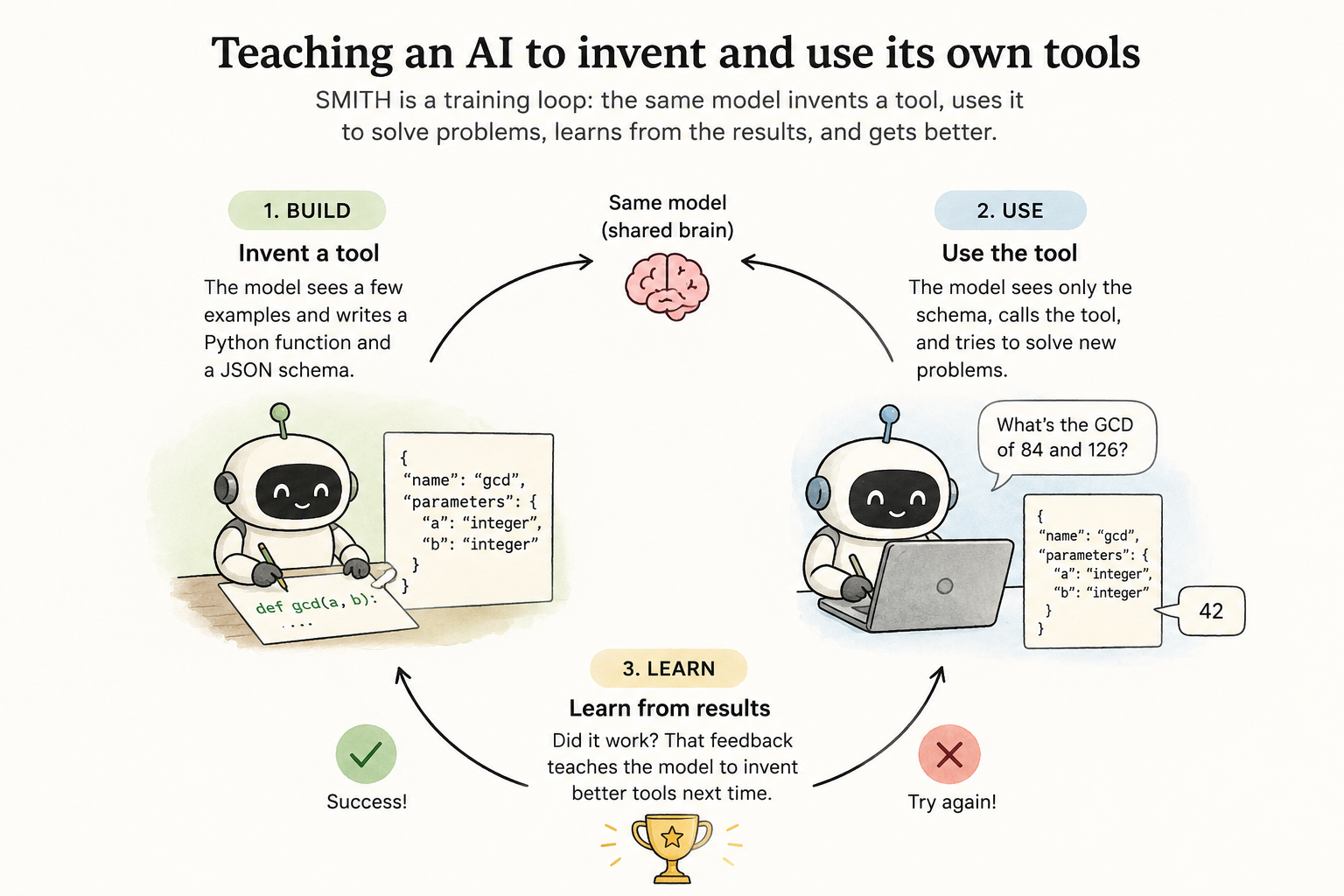
SMITH is a training loop, not a fixed pipeline: the same policy invents a tool, uses it to solve problems, and is optimized on whether that use succeeds. That feedback is what keeps tool creation improving over time.
Tool-augmented language models are bounded by the APIs humans bothered to write; existing tool-creation systems patch this by prompting a frozen LLM at inference time, leaving the model that writes a tool decoupled from the one that uses it, with no signal that the schemas it produces are schemas it can actually invoke. We propose SMITH (Schema-grounded Multi-task Iterative Tool Honing), a reinforcement learning framework that jointly trains tool creation and tool use inside a single policy. Each rollout is either a build task (write a tool from a few examples) or a use task (invoke a pooled tool on a held-out question). Three separate reward axes catch schema, code, and outcome failures independently, so each failure mode contributes its own gradient. A 4B Qwen3 trained with SMITH on 13 procedural reasoning tasks with exact verifiers reaches 79.9 macro-average accuracy on held-out tasks, the best across all evaluated methods and ahead of an untrained 30B-A3B tool-writer. It also reaches 40.4 on TabMWP-Hard and 42.6 on out-of-domain GQA (+7.6 over the best same-backbone inference-time baseline), without any visual or tabular training data. When invoked by a frozen 350M student, tools written by our 4B match those produced by a writer an order of magnitude larger.
Key results:
- 79.9 macro-average accuracy on held-out Reasoning-Gym tasks (best of all methods)
- 32× fewer output tokens than standard CoT
- +7.6 points on out-of-domain GQA vs. best same-backbone baseline
- 42.9 held-out accuracy for a 350M model using SMITH's tools
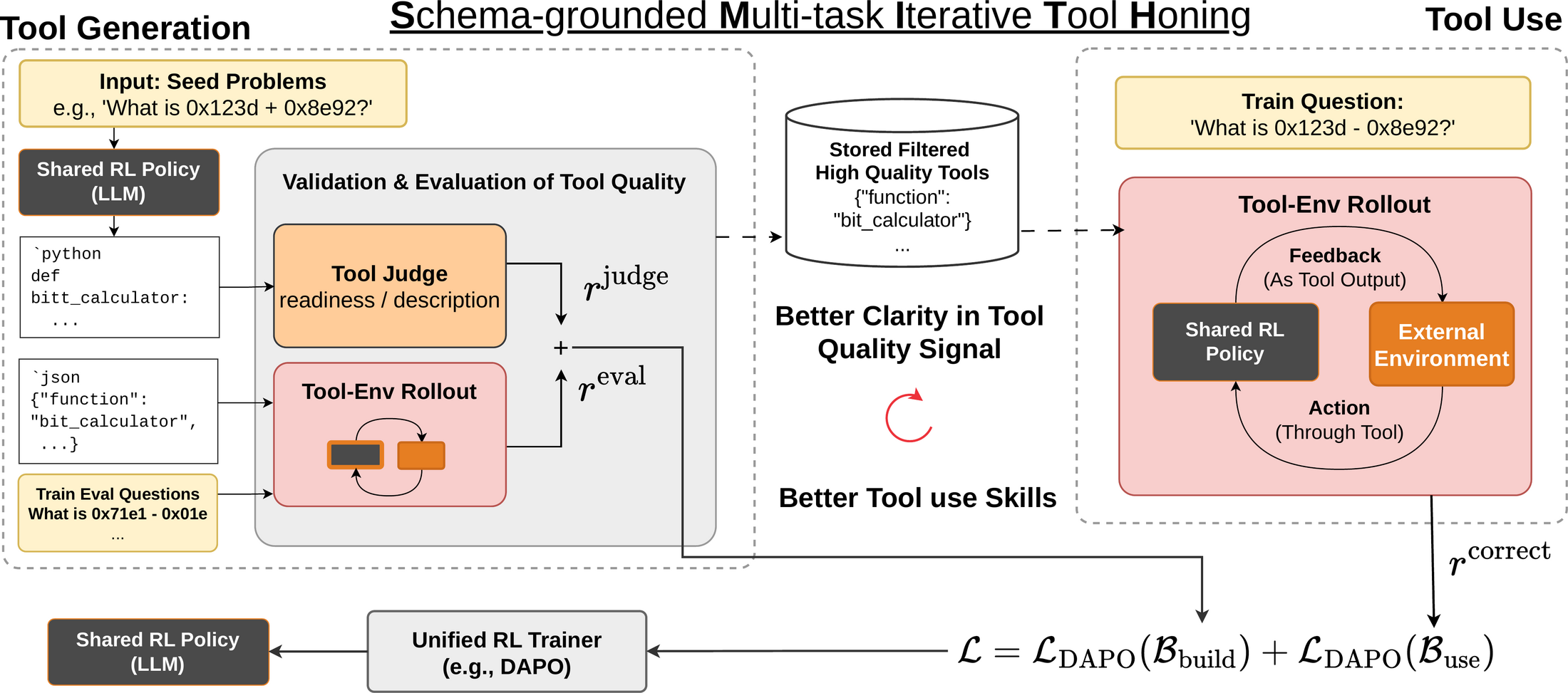
SMITH is a multi-task RL framework trained with DAPO (a clip-higher variant of GRPO) that mixes two rollout types into every batch: build and use. Both are optimized inside the same policy, so gradients from tool creation and tool consumption update the same weights every step.
The policy sees N=4 question–answer pairs and must infer the general procedure behind them, then express it as an OpenAI-compatible (Python function, JSON schema) pair. The tool is run against K=16 held-out questions drawn from a harder difficulty band; tools that pass are stored in a shared pool.
The policy receives a target question and a pool entry — one matching domain tool plus two distractor tools — and has up to T=5 turns to call the tool and answer. An efficiency penalty discourages burning through the turn budget.
| Axis | What it checks |
|---|---|
| Format | Response contains exactly one Python block and one JSON block whose function name and parameters match |
| Evaluation | A LoRA-synced evaluator model must call the tool to answer each held-out question; only tool-call answers count |
| Judge | An LLM judge scores code correctness, schema quality, and overall quality as a separate axis |
The evaluator and judge both start from the same base checkpoint as the policy, then are periodically re-synced to the latest policy weights, breaking the instability of scoring against live weights.
| Method | Seen Avg | Unseen Avg | I/O tokens |
|---|---|---|---|
| Standard CoT | 58.0 | 55.7 | 173 / 3,206 |
| LATM (Qwen3-4B) | 77.6 | 58.3 | 607 / 174 |
| LATM (Qwen3-30B-A3B) | 74.0 | 74.1 | 659 / 405 |
| CRAFT | 74.1 | 76.5 | 1,226 / 418 |
| TroVE | 52.6 | 55.9 | 347 / 575 |
| KTCE | 61.0 | 65.1 | 319 / 404 |
| ReTool (distill Qwen-32B) | 92.2 | 63.2 | 1,707 / 633 |
| LATM (distill GPT-4.1) | 81.7 | 65.8 | 638 / 207 |
| SMITH (ours) | 85.2 | 79.9 | 664 / 100 |
| Method | TabMWP-Hard | GQA |
|---|---|---|
| Standard CoT | 7.2 | 11.5 |
| LATM (Qwen3-4B) | 19.7 | 35.0 |
| CRAFT | 30.0 | 21.9 |
| TroVE | 36.4 | 21.4 |
| ReTool | 3.0 | 26.1 |
| LATM (distill GPT-4.1) | 7.1 | 56.0 |
| SMITH (ours) | 40.4 | 42.6 |
| Method | RG (Seen) | RG (Unseen) | TabMWP | GQA |
|---|---|---|---|---|
| Qwen3-8B (base) | 72.6 | 72.2 | 42.4 | 17.3 |
| SMITH: Qwen3-8B | 79.4 | 81.7 | 56.7 | 28.7 |
| Granite-3.3-8B (base) | 31.2 | 22.0 | 3.9 | 7.8 |
| SMITH: Granite-3.3-8B | 39.1 | 28.5 | 4.5 | 11.7 |
smith/
├── data/
│   └── tabmwp_hard.zip          # TabMWP-Hard dataset (5,000 examples)
├── tasks/                        # 23-task algorithmic dataset creation
│   ├── create_all_datasets.py
│   ├── utils.py
│   ├── __init__.py
│   └── <23 task files>.py
└── tool_rl/                      # Core RL training code
    ├── decompose_rollout_manual_refact_w_judge_rewards_with_tool_pool_lora_sync.py
    ├── judge_utils.py
    ├── rewards.py
    ├── tools.py
    ├── decompose_rollout_utils.py
    ├── decompose_single_q_rollout_external.py
    ├── llm_judge_eq.py
    ├── xgrammar_schema_check.py
    └── run_tool_rl_decompose_4b_judge_external_lora_sync.sh
data/tabmwp_hard.zip contains tabmwp_hard_hf_5k_fixed.jsonl (5,000 examples), a strengthened tabular-reasoning benchmark used for OOD evaluation.
cd data && unzip tabmwp_hard.zipEach line is a JSON object with the fields question, answer, table, and metadata.
The 23 training/evaluation tasks are:
ab, base_conversion, bitwise_arithematic, caesar_cipher, calendar_arithmetic,
chain_sum, count_bits, countdown, cryptarithm, gcd, isomorphic_string,
knights_knaves, lcm, polynomial_equations, polynomial_multiplication,
prime_factorization, propositional_logic, simple_equations, simple_integration,
spell_backward, syllogism, tower_of_hanoi, word_ladder.
Each task file generates train/validation/test splits using reasoning_gym.
pip install reasoning_gym
python tasks/create_all_datasets.py
Note: Dataset creation only needs to be run once. Each task's
init_data()pushes splits to HuggingFace Hub. After the first run, load datasets directly viaload_dataset(...)(seeload_ds()in each task file).
pip install trl vllm openai xgrammar reasoning_gymdecompose_rollout_manual_refact_w_judge_rewards_with_tool_pool_lora_sync.py
├── rewards.py ← answer-matching + llm_judge_eq
├── judge_utils.py ← judge call helpers
├── xgrammar_schema_check.py
├── decompose_single_q_rollout_external.py
│ └── decompose_rollout_utils.py
│ └── tools.py ← sandboxed code execution
└── llm_judge_eq.py ← LLM-as-judge equality check
The shell script run_tool_rl_decompose_4b_judge_external_lora_sync.sh reproduces the main experiment (Qwen3-4B, LoRA r=64, DAPO, 60 steps).
First, start the two vLLM servers:
# Evaluator (LoRA-sync, port 9002)
VLLM_ALLOW_RUNTIME_LORA_UPDATING=True python -m vllm.entrypoints.openai.api_server \
    --model Qwen/Qwen3-4B-Instruct-2507 --port 9002 --enable-lora

# Fixed judge (port 9003)
python -m vllm.entrypoints.openai.api_server \
    --model NVFP4/Qwen3-30B-A3B-Instruct-2507-FP4 --port 9003
Then launch training:
bash tool_rl/run_tool_rl_decompose_4b_judge_external_lora_sync.shAdd --report_to wandb --wandb_entity <your_entity> for W&B logging.
The code-execution sandbox (tools.py) defaults to an in-process subprocess runner. Set TOOL_RL_USE_SANDBOX=1 and TOOL_RL_SANDBOX_URL to point at a remote sandboxed executor for isolated execution.
@article{tam2026smith,
  title   = {Joint Optimization of Tool Creation and Use for Large Language Model Agents},
  author  = {Tam, Zhi Rui and Lin, Chieh-Yen and Chen, Yun-Nung and Sun, Shao-Hua and Lee, Hung-yi},
  year    = {2026},
  journal = {arXiv preprint},
  url     = {https://tool-use-smith.github.io}
}