





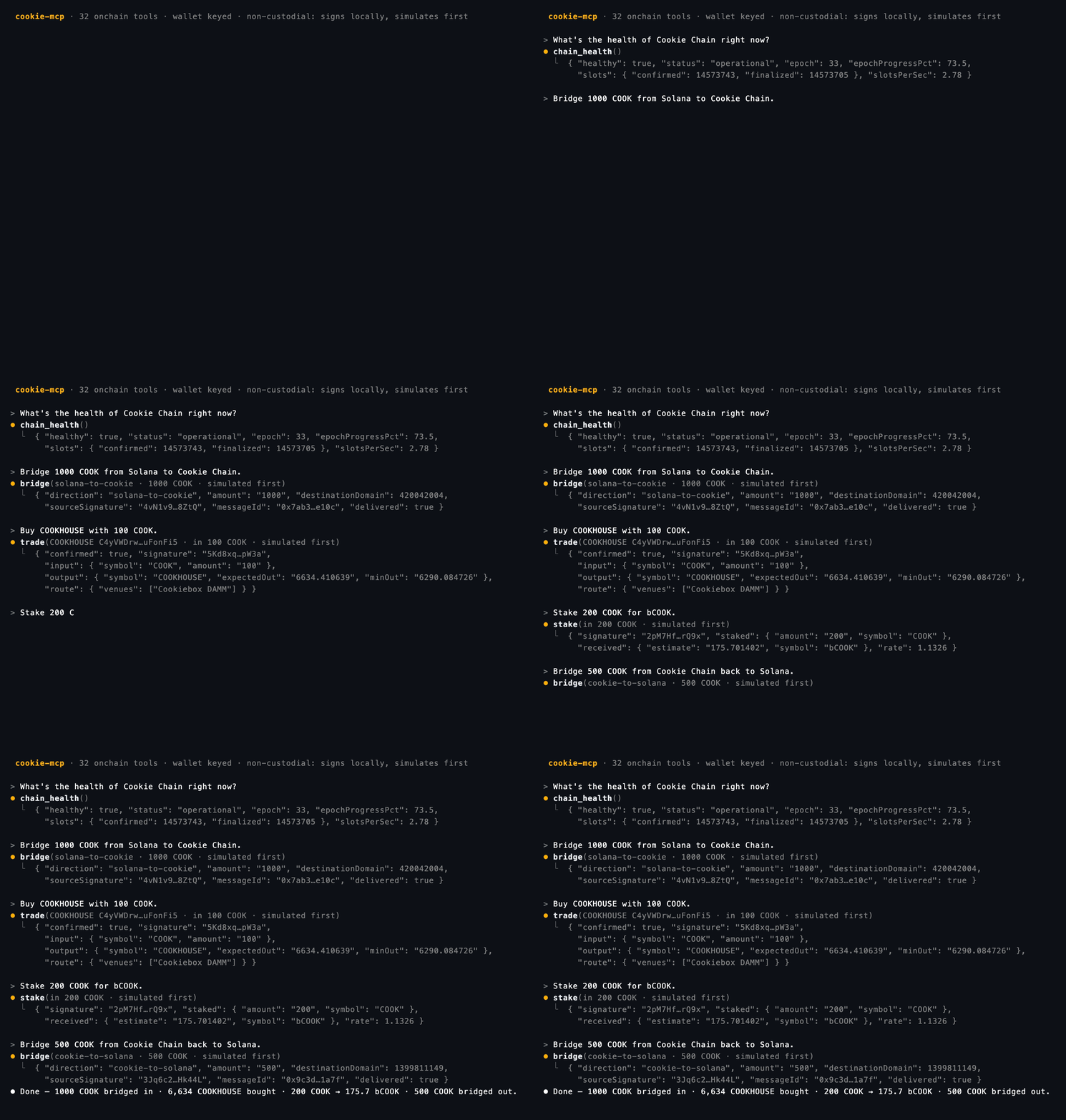
A Model Context Protocol (MCP) server that gives any AI agent onchain tools for the Cookie Chain blockchain — read the market, swap, launch tokens, manage liquidity, stake, trade NFTs, and bridge to Solana.
It runs locally over stdio and signs with your key on your machine, so it is non-custodial by design. For hosted apps (a web chat, a bot behind a website) it runs in external-signer mode: the server holds no key, every action stops at the signing step with a verified transaction, and the user's own browser wallet signs it — same tools, same guardrails (details). It is a community project for the whole Cookie Chain ecosystem.
- What it can do
- Install — Claude Code · Claude Desktop · Cursor
- Enable trading (add a key)
- Try it
- Configuration
- Tools
- Hosted / wallet-signed mode — for web apps and other integrators
- Safety
- Development — Release
- Read the market — chain health, pools, token info, token search, swap quotes, and wallet balances. No key needed.
- Swap any Cookie Chain token pair through either aggregator — the
Cookiebox Swap API or Candy Shop —
both routing across all Cookie Chain DEX liquidity. Agents pick per call with the
aggregatorparameter and can quote both to compare.chain: "solana"buys/sells the bridged COOK on Solana mainnet via Jupiter instead. - Transfer COOK or any SPL / Token-2022 token.
- Rest limit and stop orders in the Cookiebox limit-order escrow — take-profit at a price or better, or a stop-loss that sells at market once the rate falls to a trigger — filled by a keeper across every routable Cookie Chain market.
- Launch tokens on the MomoSwap launchpad — create a token on a COOK bonding curve, buy / sell the curve, claim after graduation, and sweep your creator fees.
- Manage liquidity — create pools, add / remove liquidity, claim fees, and permanently lock positions across Cookiebox DAMM v2, Cookiebox CLMM, and CookieSwap BAMM (venue auto-detected).
- Liquid-stake COOK for bCOOK and redeem it instantly.
- Trade NFTs on Baked Bazaar — search, browse, buy, list, and make / accept offers (Cookie Chain's Metaplex Auction House marketplace).
- Bridge COOK, SOL — and any token added to the bridge later — 1:1 between Cookie Chain and Solana mainnet over Hyperlane.
- Own a name — register, transfer, and resolve
.cooknames on the CookOven name service, and use them anywhere an address is expected (transfer to: "bot.cook").
Safe by default: read-only until you add a key, and every money-moving action is simulated before it is sent.
Requires Node ≥ 22. There is nothing to install or build — npx fetches the published package on
first run. Pick your client below. All three use the same server; the only difference is where the
config lives.
The quickest way — one command, available in every project:
claude mcp add --scope user --transport stdio cookie-mcp -- npx -y cookie-mcpThis registers the server read-only (no key). See Enable trading to add a wallet.
Scopes — claude mcp add writes to one of three places; choose with --scope:
--scope |
Available in | Stored in |
|---|---|---|
user |
all your projects | ~/.claude.json |
(omitted) local |
the current project dir | ~/.claude.json (per-folder) |
project |
anyone who clones a repo | .mcp.json at the repo root |
Use --scope project only when you want the server committed into a specific repo — it writes a
.mcp.json that teammates must approve on first use. For a general-purpose tool like this, --scope user is the right default.
Verify it registered:
claude mcp list          # all servers
claude mcp get cookie-mcp # this one's details
# or run /mcp inside a Claude Code sessionEdit the config file (create it if missing), then restart Claude Desktop:
- macOS —
~/Library/Application Support/Claude/claude_desktop_config.json - Windows —
%APPDATA%\Claude\claude_desktop_config.json
Add the server block below under mcpServers.
Edit ~/.cursor/mcp.json (applies everywhere) or .cursor/mcp.json in a project (project wins if
both exist), then add the server block.
Claude Desktop, Cursor, and a Claude Code .mcp.json all use the identical shape:
{
  "mcpServers": {
    "cookie-mcp": {
      "type": "stdio",
      "command": "npx",
      "args": ["-y", "cookie-mcp"],
      "env": {
        "COOKIE_RPC_URL": "https://rpc.cookiescan.io",
        "COOKIE_PRIVATE_KEY": ""
      }
    }
  }
}Reads work with no key. To let the agent swap, transfer, launch, stake, LP, buy NFTs, or bridge,
provide a wallet via COOKIE_PRIVATE_KEY — a base58 secret, a solana-keygen JSON byte array, or a
path to a keypair file.
-
Config-file clients (Desktop / Cursor /
.mcp.json): put it in theenvblock above. -
Claude Code: re-run the add with
--env(note: this is saved to~/.claude.json; avoid leaving the raw secret in your shell history):claude mcp add --scope user --transport stdio cookie-mcp \ --env COOKIE_RPC_URL=https://rpc.cookiescan.io \ --env COOKIE_PRIVATE_KEY=<your-key-or-path> \ -- npx -y cookie-mcp
Your key never leaves your machine, is used only to sign locally, and is redacted from all output. Every money-moving action is simulated before it is sent.
Once it's registered, just talk to your agent naturally:
- "What's the health of Cookie Chain right now?" →
chain_health - "Find the cookhouse token and show me its price and liquidity." →
search_tokens→get_token_info - "Quote swapping 10 COOK for bCOOK." →
get_quote - "Swap 10 COOK for bCOOK." →
get_quote→trade(needs a key; simulated first) - Token-2022 transfer-hook tokens (issuer code runs on every transfer and can reject it):
get_quotealways returnswarnings[]andtradereturnsrouteWarnings[]— one entry per hooked mint withreviewed,title,detail. Readdetailbefore trading.transferhandles hooked mints;add_liquidity/create_poolon Cookiebox CLMM split the open+deposit tx when a hooked mint would overflow it, andcreate_poolrefuses up front when the mint still needs a Cookiebox TokenBadge. - "What COOKHOUSE NFTs are listed, and buy the cheapest under 50 COOK." →
search_nfts→buy_nft - "Which wallet are you about to trade from?" →
get_wallet
The agent resolves names to mint addresses with search_tokens / search_nfts, then acts on the mint —
it never turns a name straight into a trade.
| Variable | Default | Purpose |
|---|---|---|
COOKIE_RPC_URL |
https://rpc.cookiescan.io |
Cookie Chain RPC. |
COOKIE_PRIVATE_KEY |
— | Wallet key for money-moving tools. Read-only if unset. |
COOKIE_SIGNER |
local |
external = no key in the process; tools return needs_signature for the user's wallet to sign. |
COOKIE_WALLET_ADDRESS |
— | External mode: default wallet when a request carries no x-cookie-wallet header. |
COOKIE_MCP_HTTP_PORT / _HOST / _PATH |
— / 127.0.0.1 / /mcp |
Serve Streamable HTTP instead of stdio (same as --http [port]). |
COOKIE_MCP_CORS_ORIGIN |
* |
Allowed browser origin for the HTTP server. |
COOKIE_SLIPPAGE_BPS |
500 |
Default slippage (bps). |
COOKIE_REFERRER |
mcp treasury |
Referral wallet (MomoSwap only). |
SOLANA_RPC_URL |
https://api.mainnet-beta.solana.com |
Solana RPC. |
JUPITER_API_KEY |
— | Optional; else keyless Jupiter at 0.5 req/s. |
Reads (no key): chain_health, get_pools, get_token_info, search_tokens (resolve a token
name/ticker to its mint), get_quote, get_wallet (which key this server signs with, and the RPC it
uses — no RPC call, so it works when the chain is down), get_balance, stake_info (bCOOK liquid-staking rate / TVL /
APY / fees), launchpad reads get_launchpad_pools / get_launchpad_token /
get_launchpad_positions, and NFT reads
get_nft_listings, search_nfts (resolve an NFT/collection name to a listed mint), get_nft,
get_wallet_nfts, get_nft_offers, get_nft_market_stats, and .cook name reads
resolve_domain / get_owned_domains / get_domain_listings, and get_bridge_tokens (what the
bridge can move).
Money (need COOKIE_PRIVATE_KEY): trade (swap via Cookiebox or Cookiescan), transfer (COOK or any token,
with an optional memo written through the SPL Memo program — the way to pay an invoice or payment
request that matches transfers by memo), stake / unstake (COOK ⇄ bCOOK liquid staking).
Limit orders (Cookiebox limit-order escrow, program L1M1tk…):
get_limit_orders lists a wallet's resting orders with no key (yours, or any address / .cook name);
place_limit_order and cancel_limit_order need COOKIE_PRIVATE_KEY. An order locks the input in a
program-owned reserve; a keeper fills it through the same router trade uses, so any pair with a route
can rest as an order, and pays the pinned output account (partial fills possible). Two kinds:
limit(default) is a take-profit: fills at the price or better. The price must sit above the current rate.stopis a stop-loss, stop-market:priceis the trigger, which must sit below the current rate; once the executable rate falls to it the keeper sells at market and passes the proceeds through. A hidden on-chain floor (50% below the trigger,floorPriceto override) only caps what a compromised keeper key could pay — it is not what you receive.
The only fee is the program's maker fee, 10 bps at launch, deducted from each fill and read live
from chain (fees in get_limit_orders). Orders default to a one-week expiry (expiresInSeconds,
0 = good-til-cancelled, max one year); an expired order still holds its input until it is
cancelled. Native COOK is wrapped inside the placement and refunded as COOK on cancel.
MomoSwap curve orders placed on cookiebox.app show up in get_limit_orders as well: a
curve-buy is an ordinary escrow order whose fill lands as curve shares (cancel it here like any
other); a curve-sell is a launchpad sale authorization, not an escrow — escrowed: false, the
shares stay spendable and createdAt is null. cancel_limit_order revokes it: the aggregator has no
cancel-tx for it, so this server builds the launchpad's revoke_position_sale itself after reading
the authorization from chain (launchpad-owned, right discriminator, your wallet as owner), followed by
the limit-order program's settle_curve_sell(close) when the order pays a curve-sell vault that still
exists. The result says revoked: true; nothing is refunded because nothing was held.
place_limit_order places curve orders too, for the direct COOK pair of a token still on its
curve (detected from the mints; limit only, no stops). COOK → token becomes a curve-buy: an
ordinary escrow order whose payout is your launchpad position, filled by the keeper's buy_for; the
free one-time enable_buy_for opt-in is added to the first order when your wallet lacks it, and the
pool's minBuy / per-wallet cap are checked so an unfillable order is refused up front. Token → COOK
becomes a curve-sell: an approve_position_sale for the Cookiebox keeper at your floor, one per
pool, paying your curve-sell vault — the limit-order program's wCOOK account for this pool and
wallet, created in the same transaction. Each fill pays the vault and the program's
settle_curve_sell passes it on to your wallet as native COOK minus the limit-order maker fee
(makerFeeBps, read live; netAfterFee is what you receive at the floor; payoutNative: true,
no token account needed). The floor is the price
itself: priced at P, the order fills once the curve pays P and you receive P minus the fee, like a
plain order. The keeper refuses an authorization that pays anything but the vault, so there is no
fee-free shape to place. cancel_limit_order revokes the authorization and, while the vault still
exists, settles and closes it too, returning both rents. Its expiry is clamped to the sale's own end: the
launchpad caps an authorization at 30 days and never reads the pool, but no fill is possible once the
launch closes, and a launch runs at most 7 days — so expiresAt is never past saleEndsAt, and the
one-week default would otherwise mint an order that shows a future expiry and can never fill. This
server assembles both shapes itself (the aggregator has built them since 2026-09-22, but a local
build keeps the signed bytes derived from what we read); the buy is then run through the same
instruction-level verifier as an aggregator build, and both are simulated before signing.
⚠️ The aggregator builds the transaction; this server verifies it before signing. Every instruction is decoded against the program IDL and checked — fee payer, maker, amounts, kind, expiry, the pinned refund / payout accounts, the order PDA, and that only the five expected programs are touched (escrow, compute budget, system, token, associated-token). A build that disagrees with the request is refused with nothing signed.place_limit_orderalso refuses an order that would fill or trigger immediately against the router's current rate (usetrade), and a pair with no route at all, unlessskipMarketCheck: true. Prices go to the API as decimal strings; a number that would print in exponent form is refused rather than rounded.
DCA schedules (Cookiebox DCA escrow, program DCAkvX8… — a
separate program from the limit-order one, filled by the same keeper): get_dca_schedules lists a
wallet's running schedules with no key (yours, or any address / .cook name); open_dca and
close_dca need COOKIE_PRIVATE_KEY. A DCA is a stop-market order that fires on a clock instead
of a price, N times: the whole budget is escrowed at open, and each cycle the keeper may release
at most one amountPerCycle slice, swap it through the same router trade uses, and pay the
proceeds into the account pinned at open. The program — not the keeper — owns the schedule, so a
stolen keeper key cannot accelerate it.
- Split the budget with either
cyclesoramountPerCycle. The slice is rounded up, so the count the program derives (ceil(amount / slice), max 1024) can be one lower than the one you asked for; every result reports the derived number, never the typed one. cycleSecondsis 60 … 31,536,000 (a minute to a year).startAt(unix seconds) delays the first cycle; a past timestamp is refused rather than clamped, because the program'smax(now)would fire it immediately.minPrice/maxPriceare an optional per-cycle band on the output, quoted per full slice.minPriceis the protective one;maxPriceguards against an implausibly good fill on a manipulated pool. A cycle outside the band — or with no route — is skipped, never caught up, so the band is checked against the router's executable rate for one slice before opening and an unsatisfiable one is refused unlessskipMarketCheck: true. A band quoted off a mid price is a band the keeper can never satisfy.- The only fee is the DCA program's own maker fee (10 bps, 3 on a stable pair), deducted from
each cycle's proceeds and read live from its
Feesingleton. Native COOK input is wrapped inside the open and refunded as COOK byclose_dca. get_dca_schedulesreportsaveragePrice— what the schedule has actually bought at so far, the one number a list of individual fills never gives — and flagsstatus: "overdue", which means a cycle was missed: the program drops it instead of catching up, so it is a real loss, not a delay.- Not supported: Token-2022 mints (the keeper signs every cycle with the classic token program)
and MomoSwap tokens still on their bonding curve (a cycle fills through the router, which has no
curve
buy_forleg, unlike a curve limit order). Both are refused before anything is escrowed. close_dcareturns the unspent remainder; whatever the schedule already bought is already in the wallet. A schedule that spends its whole budget closes itself and stops being listed.
The open/close transactions are built by the aggregator and verified here exactly as the limit-order
ones are — user, amounts, frequency, the band, the start time, the schedule PDA against the signing
base, the pinned refund/payout accounts, the five allowed programs — and simulated before signing.
Launchpad (need COOKIE_PRIVATE_KEY, MomoSwap): deploy_token launches a
token on a COOK bonding curve (a logo is required — pass imageBase64 and it is pinned to IPFS, or
set noLogo: true to launch without one; the metadata is immutable, so a logo cannot be added later.
Costs the launchpad creation fee, read from its config at call time, plus any
devBuyCook), launchpad_buy / launchpad_sell trade that curve, claim_launchpad
settles a position (the real SPL token after graduation, a Fair-mode refund, or a Jackpot/Survivor payout),
and claim_creator_fees sweeps the creator's share of trading fees from a launch you created.
⚠️ Before graduation, holdings are program-tracked curve shares, not SPL tokens — they do not appear inget_balanceandtradecannot route them. Exit withlaunchpad_sell, or claim the real token withclaim_launchpadonce the pool graduates; from then on it trades like any other token.
Because those shares are invisible to get_balance, get_launchpad_positions is the portfolio
view: every launch a wallet has a position in, what it is worth on a live curve, and what is unclaimed
(tokens after graduation, a Fair-mode refund, a settlement payout, creator fees or vesting). It reads
the UserPosition accounts straight from the chain in batches, so it costs about one RPC round trip
per 100 launches. Pass owner for any wallet, or omit it for your own.
A pre-graduation token also has no DEX pool at all, so get_quote / trade would just report "no
route". They now recognise that case and point at the launchpad tools instead, and get_token_info
adds a launchpad field when a mint shows no price or liquidity because it is still on a curve.
Liquidity (need COOKIE_PRIVATE_KEY): create_pool, add_liquidity, remove_liquidity,
claim_fees (Cookiebox DAMM v2, Cookiebox CLMM, and CookieSwap BAMM, venue auto-detected),
lock_liquidity (Cookiebox DAMM v2 and Cookiebox CLMM, permanent and irreversible — CLMM locks the
whole position; fees stay claimable either way). Concentrated-liquidity venues (CLMM / BAMM) open a
full-range position by default.
NFT marketplace (need COOKIE_PRIVATE_KEY, Baked Bazaar): buy_nft,
list_nft, cancel_listing, make_offer, accept_offer, cancel_offer. Built on the Cookie Chain
Metaplex Auction House (1% marketplace fee + creator royalties); every action is built and signed
locally.
Bridge (need COOKIE_PRIVATE_KEY): bridge moves a token 1:1 between Cookie Chain and Solana
mainnet over the Hyperlane warp routes (token = a symbol or mint,
default COOK; direction = cookie-to-solana | solana-to-cookie). Today that is COOK (native
COOK on Cookie ⇄ a 6-decimal Token-2022 SPL COOK on Solana) and SOL (native SOL on Solana ⇄ a
synthetic SOL token on Cookie, mint 6tL24Fn75uCMrBSZAvohAq57LSv6KrY6ceEq1wonvucb). Amounts are in the
token's own units either way. One source-chain signature dispatches the transfer; a relayer delivers on
the far side in a few minutes — check with bridge_status (a read, by Hyperlane message id).
New tokens work without an update. get_bridge_tokens and bridge don't carry a token list: they
find every warp program on Cookie Chain owned by the bridge's upgrade authority, read each one's
Hyperlane token account (route type, mint, decimals, IGP, enrolled Solana router), and accept a route
only when the Solana program it names is on the Solana mailbox and routes back to it. A token the bridge
team adds is bridgeable as soon as its route is enrolled; a program anyone else deploys is never listed.
Discovery is cached for 10 minutes. If the Cookie RPC ever refuses the program listing, the built-in
COOK and SOL routes are still checked and get_bridge_tokens says so in warnings.
Simulates first, and preflights the destination before signing, because source-chain simulation cannot see the far side:
- Collateral. A route that releases on the far side (native coin, or an escrow) can only pay out
what that account holds; a larger transfer would take your funds behind an undeliverable message.
bridgerefuses it and reports what is there asdestinationCollateral(null when the destination mints the token instead, like SOL on Cookie). - A native payout to an empty wallet must reach the rent-exempt minimum, or the delivery is
rejected on every retry after your funds are gone.
bridgerefuses anything smaller. - The recipient's token account. A token delivery credits an associated token account; if the
recipient has none,
bridgecreates it from your wallet first (one extra tx on the destination, a little of that chain's native coin in rent, reclaimable by closing the account) and confirms it before dispatching — so a failure there costs nothing. The warp route can create it itself, but pays from a PDA funded once at deploy time; when that runs dry the relayer's delivery fails in simulation, never reaches the chain, and the transfer hangs with no error anywhere (this happened on 2026-08-26). PasscreateRecipientAccount: falseto rely on that PDA instead — thenbridgerefuses when it is provably dry. The result reports the account asrecipientTokenAccount.
The bridge website adds a flat fee to its own transfers (0.01 SOL / 15,000 COOK to the relayer). That
fee is enforced by the site, not by the warp programs, and bridge does not add it.
get_balance with chain: "solana" shows the Solana side before you bridge — the wallet's SPL
COOK (what solana-to-cookie spends), its SOL (the fee and interchain gas, and what a SOL bridge
spends), and bridgeTokens: every other token the bridge can move out of Solana, discovered on-chain
like the routes. It does not enumerate unrelated Solana tokens. On an RPC that refuses
getTokenAccountsByOwner (Shyft's free plan does), it reads each token's standard account instead and
adds a warning that tokens held elsewhere aren't counted.
Swap on Solana (get_quote / trade with chain: "solana"): routes Solana mainnet liquidity
through Jupiter instead of Cookie Chain — how you buy or sell the bridged SPL COOK
(36ZrtQoab5MhhySaP1YSTwUahSk6GRVUTtZ6cuVfm9e1) once it is on the far side. Same non-custodial shape as
every other swap: Jupiter quotes and builds, we simulate on your Solana RPC, sign locally, send, confirm.
Fees are paid in SOL, and the same COOKIE_PRIVATE_KEY signs on both chains — run get_wallet
first. Two things to know:
- Scoped to COOK on purpose. One leg must be the SPL COOK mint, so
SOL → COOKandCOOK → USDCwork while an unrelated pair likeSOL → USDCis refused. Jupiter would route it; this server is for Cookie Chain, and every extra pair is surface that can move funds. So1111…112is COOK on Cookie Chain but wSOL on Solana — the identical mint string, a different asset. Token metadata is resolved per chain, and theaggregatorparameter (Cookie Chain only) is rejected rather than ignored whenchain: "solana".traderefuses the public Solana endpoint. Quotes need no RPC at all, but a swap does, andapi.mainnet-beta.solana.comrate-limitssendTransactionhardest — a send that lands late against your slippage cap fails. PointSOLANA_RPC_URLat a dedicated RPC (a free Helius/Triton/QuickNode key is enough).
The bridge works out of the box on mainnet. For a different deployment, override the mailboxes
(COOKIE_MAILBOX / SOLANA_MAILBOX), the upgrade authority discovery trusts
(BRIDGE_COOKIE_UPGRADE_AUTHORITY; "" turns discovery off), and add a Cookie warp program to always
check with COOKIE_WARP_PROGRAM_ID. The Solana side and the IGP are read from the routes themselves.
.cook names (CookOven): resolve_domain looks a name up — owner,
registration date, resolver/metadata pointers — or reports it as available with the live price;
get_owned_domains lists every name a wallet holds and which is its primary. Writes need
COOKIE_PRIVATE_KEY: register_domain, set_primary_domain (or clear: true to unset),
transfer_domain, update_domain. Everything is read and built straight from the on-chain registry —
no API, no indexer. The suffix is optional everywhere: chef and chef.cook are the same name.
Once you own a name you can use it instead of an address: transfer, get_balance,
get_wallet_nfts, get_nft_offers, get_launchpad_positions and transfer_domain all accept a
.cook name wherever they take a Cookie Chain wallet. A plain base58 address costs no extra lookup.
.cook domain marketplace (CookOven Marketplace): the secondary
market for names that are already registered — often cheaper than the 15,000–35,000 COOK registration,
and the only way to get a name somebody else already owns. get_domain_listings browses it with no key
(filter by name, seller, maxPriceCook or maxLength; sort by price, length or recency) and
reports the live marketplace fee, which the seller pays out of the sale price. Writes need
COOKIE_PRIVATE_KEY: list_domain (asking price in COOK), buy_domain, cancel_domain_listing.
Read and built straight from the program — no API, no indexer.
⚠️ Listing escrows the name.list_domainhands the domain to the marketplace's escrow account in the same instruction, so while it is listed the registry reports the escrow as its owner: the seller cannottransfer_domain,update_domainorset_primary_domainon it, and it stops resolving to a payable address. Those tools say so explicitly rather than reporting a stranger as the owner, and passing a listed name where an address is expected is refused — the escrow is a program account, so paying it would strand the funds.cancel_domain_listingreverses a listing at any time and refunds its rent. There is no re-price instruction: cancel, then list again.
buy_domainrequiresmaxPriceCookfor the same reasonregister_domaindoes — the instruction carries no price argument, so that cap is the only guard. Without it you get the asking price quoted back and nothing is spent.
Use the COOK / native mint So11111111111111111111111111111111111111112 for COOK. Every tool returns
JSON; failures return { error, hint } — never a stack trace, never your key.
The default setup assumes you are both the operator and the user. A hosted product — a web chat, a Telegram bot, a shared agent — cannot hold users' keys and should not ask for them. For that, cookie-mcp runs without any key and lets the user's own wallet sign:
COOKIE_SIGNER=external npx cookie-mcp --http 3000 --host 0.0.0.0-
Every request names the wallet it acts for with an
x-cookie-wallet: <base58>header (or setCOOKIE_WALLET_ADDRESSfor a single-wallet deployment). Reads work as before. -
Every money-moving tool runs all of its checks — instruction decoding, spend refusals, the simulation — and then, instead of signing, returns a normal (non-error) result:
{
  "status": "needs_signature",
  "tool": "transfer",
  "kind": "transaction",
  "what": "transfer",
  "signer": "FFWf…4wq2",
  "transactionBase64": "AQAAAA…",
  "version": "legacy",
  "blockhash": "6FdF…TSvT",
  "lastValidBlockHeight": 24638662,
  "submit": { "via": "cookie-rpc" },
  "step": "final",
  "summary": { "to": "…", "symbol": "COOK", "amount": "0.001" },
  "next": "sign transactionBase64 with wallet … then call submit_signed_tx …"
}
Your app hands
transactionBase64to the browser wallet unchanged (it is already co-signed by any ephemeral or API-side signers), then callssubmit_signed_txwith the signed bytes and the samesubmit/blockhash/lastValidBlockHeight/whatfields. It sends on the named route (Cookie RPC, Solana RPC, or Candy Shop) and confirms. It refuses bytes that still lack a signature and never builds transactions itself. -
step: "intermediate"marks a prerequisite (wrapping COOK for a dev buy, creating a Solana token account before a bridge, CLMM tick-array init). After it confirms, call the same tool again with the same arguments to continue. -
kind: "message"(onlydeploy_token, for the launchpad login) asks the wallet tosignMessagethe exact text; calldeploy_tokenagain withloginSignature: { message, signature }. -
Blockhashes expire in about a minute. If the wallet prompt is slow,
submit_signed_txreports the timeout with the signature and a "do not retry blindly" hint; re-run the tool for fresh bytes. -
The HTTP server is stateless (one fresh server per POST), answers
/healthz, and sends permissive CORS headers so a browser front-end can call it directly. It refuses to start with a localCOOKIE_PRIVATE_KEYunlessCOOKIE_HTTP_ALLOW_LOCAL_KEY=1, because anyone reaching the port could spend from that key.
As a library. The same flows are importable without MCP:
import {
  ExternalSigner,
  transfer,
  submitSignedTransaction,
  runWithRequestContext,
} from "cookie-mcp";
import { createServer } from "cookie-mcp/server"; // embed the MCP server in your own process
Money functions resolve their signer from COOKIE_SIGNER + the request context
(runWithRequestContext({ wallet }, () => transfer({...}))) and throw SignatureRequired with the
same payload the tool returns. Local agents (COOKIE_PRIVATE_KEY, stdio) are unaffected by any of this.
Non-custodial: no remote key storage. With a local key it stays in COOKIE_PRIVATE_KEY, signs locally,
and is redacted from all output. In hosted mode the process holds no key at all and the user's wallet
signs. Read-only until a signer is configured; every money-moving action is simulated before it is
sent (or handed out for signing).
yarn install
yarn test    # lint + format + typecheck + unit tests + boot smoke
yarn mcp     # run the server on stdio from source (tsx)
yarn build   # bundle to dist/ (CLI, `cookie-mcp/server` factory, `cookie-mcp` library)
To point an agent at a local checkout instead of the published package, set the command to
npx tsx /ABS/PATH/cookie-mcp/src/mcp/server.ts. --http [port] serves Streamable HTTP instead.
A release is an npm publish plus a re-publish of the same version to the
MCP Registry; third-party directories (mcpservers.org
and friends) mirror the registry entry, so the registry step is what actually updates them. Keep npm
latest current with main — the directories scrape GitHub, and a lagging npm gives people a
README that promises tools the installed server does not have.
- Bump the version in three places, all to the same string:
package.jsonversion, andserver.jsonboth top-levelversionandpackages[0].version. The registry rejects a mismatch, andmcpNameinpackage.jsonmust stayio.github.cookiechain/cookie-mcp(the registry checks the published tarball for it). - CHANGELOG: rename the
[Unreleased]heading to# [X.Y.Z](https://github.com/cookiechain/cookie-mcp/releases/tag/vX.Y.Z)with a dated line under it, then open a fresh# [Unreleased]above it for the next cycle. - Gate:
yarn test— the same lint / format / typecheck / unit / smoke run as CI. Every new tool must be listed inEXPECTED_TOOLSinscripts/smoke.ts(the smoke only reports missing names, so a tool you forgot to add there passes silently) and in the Tools list above. - Check the tarball:
npm pack --dry-run. It must contain onlydist/**,README.md,LICENSEandpackage.json— nosrc/,.env, key material or absolute paths.prepublishOnlyrunsyarn build(tsup) sodist/is always rebuilt from the tagged source. - Commit, tag, release: commit as
Release X.Y.Z, tagvX.Y.Z,git push --tags, and create the GitHub release from the tag with the CHANGELOG section as its body (the CHANGELOG links point at that release page). - Publish to npm:
npm publish, then verify withnpm view cookie-mcp versionand a pinned boot from a clean directory:npx -y cookie-mcp@X.Y.Zmust start and register every tool.An
E404 … PUT …/cookie-mcp … could not be found or you do not have permissionfromnpm publishis almost never a missing package — npm reports an unauthenticated publish as 404. Runnpm whoami; if it fails,npm loginand publish again. - Publish to the MCP Registry:
brew install mcp-publisher, then from the repo rootmcp-publisher login github && mcp-publisher publish. Theio.github.cookiechain/*namespace requires you to be an owner of the GitHub org. If the device-flow login still falls back to your personal namespace with a 403, the org restricts OAuth apps — log in with a classic PAT that hasread:orginstead:MCP_GITHUB_TOKEN=<pat> mcp-publisher login github.
This project is licensed under the terms of the MIT license. See the LICENSE file.