The open-source agent that keeps a Hyper-V host honouring its last-known-good configuration — even when the control plane is offline.



Overview • Key Features • How It Works • Project Structure • Building & Testing • Downloads • Security • Contributing
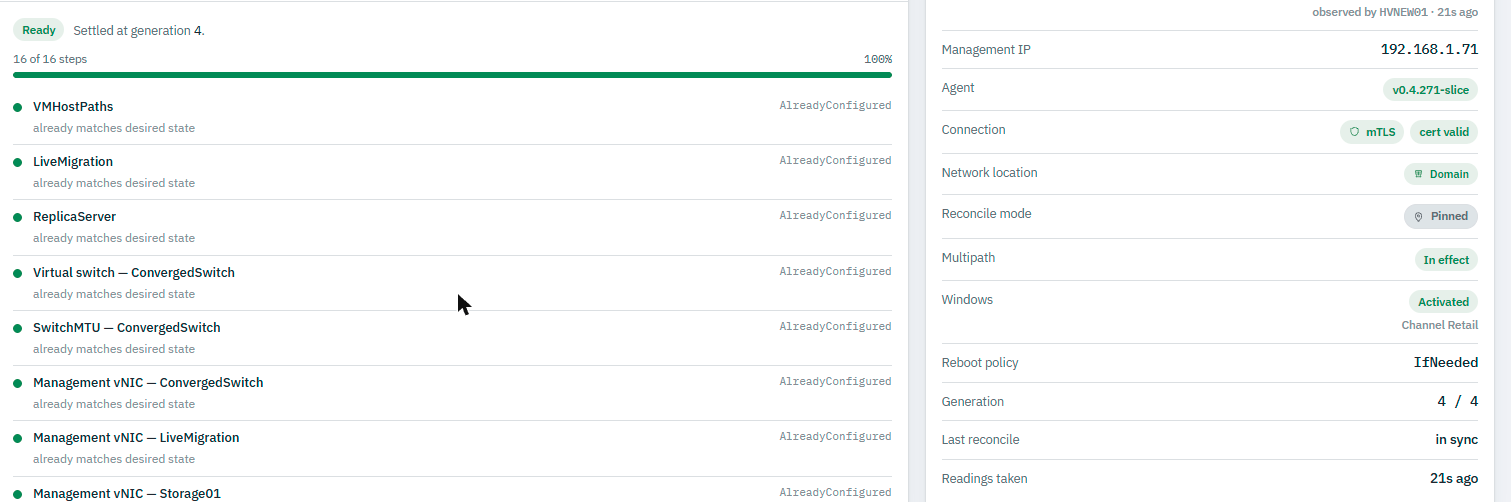
Ballast is a control plane and distributed agent for Hyper-V hosts and failover clusters — an SMB alternative to vCenter, built on Hyper-V rather than replacing it. This repository is the agent only: the Windows service that runs on each Hyper-V host, pulls its desired state from a Ballast centre, and drives the host towards it.
The orchestration centre — the control plane, console, and everything that turns a fleet of these agents into a managed platform — is closed-source and proprietary, and lives outside this repository.
Full product: https://ballast.halvantic.com/
This is the part of the product we open the source to, deliberately: it's the piece running with elevated privileges on your hypervisor hosts, and "trust us" isn't good enough for that. Read it, build it, verify it does what we say it does.
- 🔄 Idempotent Reconcile Loop: Continuously diffs actual host state against desired state and closes the gap — SET-teamed vSwitches, management OS vNICs, Storage Spaces Direct + CSV, cluster membership, and VM lifecycle. Applying the same spec twice is always a no-op.
- 🛟 Offline Autonomy: Caches the last-honoured desired state in an embedded local store. If the centre goes offline, the agent keeps enforcing exactly what it was last told — it never invents intent, and it never stops.
- 🔐 mTLS to the Centre: The centre is its own certificate authority and issues each agent a client certificate. A missing or unreadable certificate makes the agent refuse to start rather than fall back to an unencrypted connection.
- 📋 Status Journal: Reports reconcile progress, drift, and
ObservedGenerationback to the centre, and queues status locally while disconnected. - 🖥️ VMware Migration Support: Built-in VMDK streaming and snapshot handling for moving workloads off VMware onto Hyper-V.
- ⚙️ PowerShell-Module Adapter: Drives Hyper-V, FailoverClusters, Storage, and NetAdapter through their own PowerShell modules — every operation is one you could run and inspect yourself.
- 🚫 No Reimplemented Quorum: Coordinates with Windows Failover Clustering (
Test-Cluster/New-Cluster/Set-ClusterQuorum) rather than hand-rolling cluster consensus.
Ballast borrows the Kubernetes kubelet pattern for Hyper-V:
- Desired state lives centrally, on a centre this repository does not contain. It never imperatively drives a host — it only ever hands over what a host, cluster, or VM should look like.
- The agent reconciles, comparing actual state to desired state and emitting idempotent jobs to close the gap, on a continuous loop.
- The agent caches, in an embedded local store (
agent/store), the last desired state it was actually given. - Losing the centre never changes intent. The agent keeps enforcing its last-honoured state and reports itself as running autonomously (
Status.Autonomous = true) rather than degraded. - Reconnecting is automatic.
Generation(set by the centre) andObservedGeneration(reported by this agent) tell the centre whether a host is settled or has drifted, so reconciliation on reconnect needs no manual comparison.
This is the load-bearing idea of the whole product — see the desired-state and autonomy model for the full write-up, or CONTRIBUTING.md for the non-negotiables that protect it in code.
agent/
  service/      Windows-service entrypoint and lifecycle
  store/        embedded last-honoured state + status journal
  reconcile/    reconcilers (networking, storage, cluster membership, VMs)
  hyperv/       PowerShell-module adapter for Hyper-V/FailoverClusters/Storage
  vmware/       VMware-source migration support (VMDK streaming, snapshots)
api/
  types/        the desired-state schema (its own Go module — see api/go.mod)
  proto/        gRPC service and message definitions, generated via buf
version/        the agent's own release version
cmd/nfcprobe/   a standalone diagnostic for NFC export-lease behaviour
api/ is versioned independently of the agent (github.com/halvantic/hyperv-control-plane/api) because the closed-source centre depends on the same schema — this is the wire contract between an open agent and a closed centre, and it has to be able to move on its own schedule.
| Requirement | Value |
|---|---|
| Go | 1.26+ |
| OS to build on | Any — the code builds cross-platform |
| OS to run on | Windows Server, Hyper-V role enabled (Hyper-V/FailoverClusters operations shell out to PowerShell) |
# Clone the repository
git clone https://github.com/halvantic/hyperv-control-plane.git
cd hyperv-control-plane

# Build the agent
go build ./agent/service

# Run the tests (from the repository root, and separately from api/ —
# it's its own module)
go test ./...
cd api && go test ./...
Most of the reconcile logic is unit-tested without needing a live Hyper-V host, but the agent itself only builds and runs meaningfully on Windows.
Prefer a built binary over building from source? The current release, v1.0.2, is published two ways, both with SHA256SUMS for verification:
- GitHub Releases — the agent, attached to this repository's own tags.
- ballast.halvantic.com/download — the agent alongside the closed-source centre and Ballast Manager binaries.
What changed in each release is in the release notes.
| Concern | How it's handled |
|---|---|
| Agent ↔ centre transport | Mutual TLS; the centre is its own CA. Missing/unreadable cert material → the agent refuses to start. |
| Agent account privilege | Documented least-privilege AD delegation, confirmed on real AD — see docs/agent-least-privilege-ad.md. |
| Binary verification | SHA256SUMS published alongside every release (see Downloads). No code-signing yet — a checksum match proves the file wasn't corrupted or swapped in transit, not who built it. |
Full write-up, including certificate lifecycle and what's still a known gap: https://ballast.halvantic.com/docs/security
See CONTRIBUTING.md for the conventions this codebase holds to and the mental model behind it. Short version: idempotency on every reconcile operation, and the agent never invents intent — it only enforces the last desired state it was given.
Apache 2.0 — see LICENSE.