







AI Systems Engineering · Full-Stack Development · Business Automation
Epiphany Dynamics / Public repositories / Work with me / Email
I'm Patrick Gibbs, founder of Epiphany Dynamics in Nashville, Tennessee. I build AI agents, voice workflows, web applications, and the integrations around them for businesses that need the system to keep working after launch.
My work spans architecture, implementation, testing, deployment, and support. The focus is the complete workflow: the interface people use, the data it depends on, the actions it takes, and what happens when something fails.
Most of my development lives in @epiphany-dynamics. This profile connects you to that work. Private client implementations are not republished here; the public repositories showcase tools, products, and reusable engineering patterns.
|
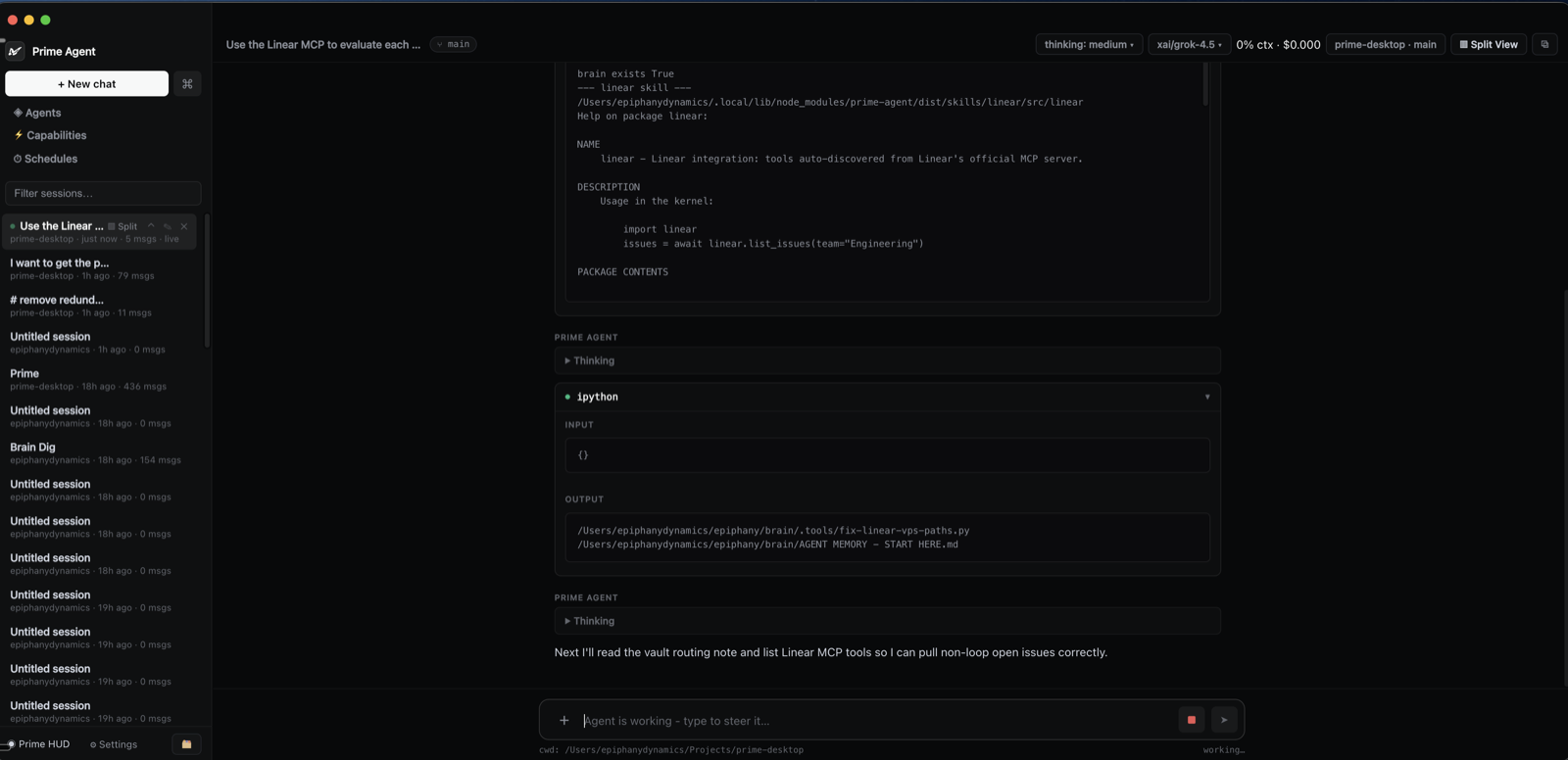
A desktop interface that doesn't own the agent's lifetime. Early public macOS client for Prime Agent: split-pane chats, live worker attachment, project context, and an agents dashboard. Close the interface without terminating background agents; reopen and reattach.
Engineering focus: process lifecycle, sandboxed rendering, narrow IPC, and smoke-test tooling. macOS downloads are currently unsigned. |
External data is unreliable. The pipeline shouldn't pretend otherwise. Reference implementations for backoff with jitter, circuit breaking, block detection, and multi-signal entity matching. Confidence bands preserve uncertainty instead of turning missing data into false conclusions.
Engineering focus: injectable mock transport, deterministic tests, graceful failure, and human-review thresholds. |
|
AI education built as a usable product. A gamified learning application with seven modules, quizzes, progress tracking, XP, and rewards. Browser-local progress works without an account; optional sign-in supports cross-device synchronization.
Engineering focus: content-driven architecture, local-first progress, optional sync, and generated discovery files. |
Correct balances need more than a happy-path test. Naive versus row-locked balance operations, row-level-security probes, and concurrency/load-test harnesses. A focused reference for investigating double-spends and access-control gaps.
Engineering focus: data invariants and overlapping writes. Database-backed verification requires a configured test environment. |
|
“The form submitted” isn't proof the notification arrived. A webhook-based reference implementation for validating form payloads, sending through a transactional provider, and tracking delivery events. Includes normalization, sanitization, and failure-path tests.
Engineering focus: observable delivery, explicit errors, and an audit trail beyond the platform's success message. |
Multiple agents, persistent context, one familiar interface. A Discord-to-Claude Code relay with per-channel routing, persistent sessions, semantic memory, and direct, dispatched, or broadcast modes. Memory retrieval supports a Mem0-to-Qdrant fallback.
Engineering focus: agent orchestration, session continuity, memory retrieval, and operator stop controls. |
More public work: voice pipelines, agent skills, and web products
| Project | What to explore |
|---|---|
| Call Speaker Diarization Kit | Python reference pipeline for identifying known speakers, handling ambiguous matches, and producing structured call records. Matching logic is runnable; embedding and transcription model calls are explicitly mocked. |
| Claude Skills Portfolio | Business-workflow skills for Claude Code, including a Python presentation generator with brand configuration, templates, and sample inputs. |
| What's Wrong With My Site | A plain-English website diagnostic product. |
| HypeBench | An AI-model attention tracker across social and developer platforms, with a public scoring methodology. It measures conversation and momentum, not model quality. |
| Field Service Stack | An Astro publishing system for contractor software reviews and guides, with schema-validated content, generated search, sitemaps, and AI-readable discovery files. |
Make success observable. A successful tool call is not the same as a successful business outcome. Verify the calendar update, delivery event, stored record, or final balance.
Design the failure path. Retries need limits. Long-running workers need a lifecycle. Ambiguous matches need a review path. Missing data should stay unknown.
Keep boundaries explicit. Separate the interface from the agent process, enforce data-access rules, and make the difference between a reference implementation and a deployed system clear.
Leave something maintainable. Readable code, reproducible setup, focused tests, documented tradeoffs, and an honest account of known limits.
Languages: TypeScript · JavaScript · Python · SQL
Applications: React / Next.js · Astro · Electron
Data: PostgreSQL / Supabase · Firebase · Qdrant
Integration & runtime: Node.js · Bun · REST APIs · Webhooks · Ollama
I also submit improvements and debugging reports to the tools I run. Selected public submissions to Hermes Agent:
- WhatsApp capability documentation — a Baileys-versus-Cloud feature matrix grounded in implemented adapter behavior.
- Technical-writing skill — a reusable checklist and tests for repository documentation and pull-request writing.
- SQLite connection-lifecycle bug report — a reproduction and proposed fix for dead-thread read connections accumulating in a long-lived gateway.
View my Hermes Agent pull requests and their current status →
For AI agents, voice systems, workflow integrations, internal tools, or a build that needs rescuing:
Epiphany Dynamics · Book a conversation · patrick@epiphanydynamics.ai