Repository navigation
Design study: lessons from KiroCrew's outer layer for Shepherd #138
Description

Context
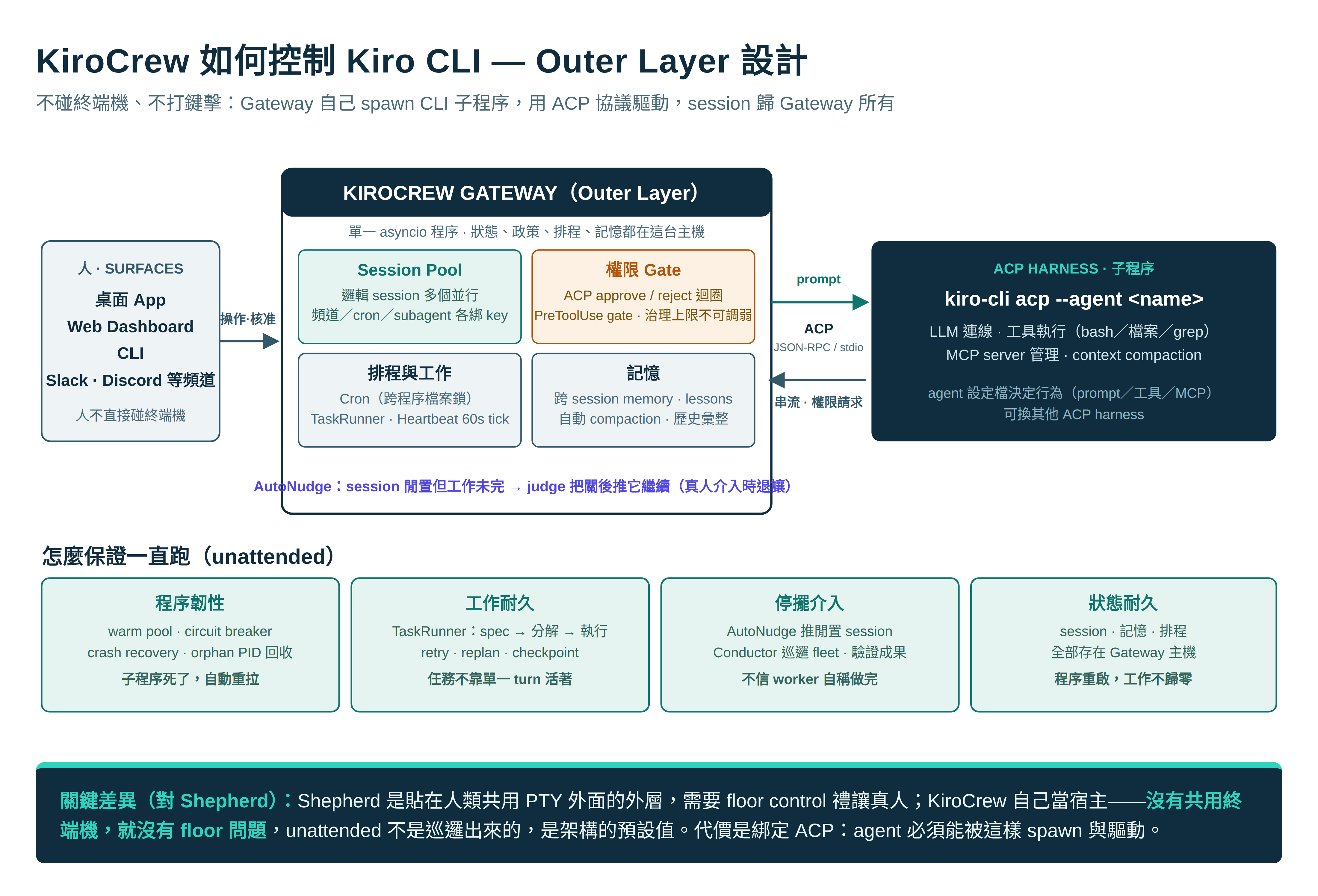
Design-study tracking issue. We studied kirodotdev/KiroCrew, an open-source agent workspace whose outer layer (the "Gateway") takes the opposite route from Shepherd: instead of attaching to a human-shared PTY, the Gateway owns the agent process — it spawns kiro-cli acp --agent <name> as a subprocess and drives it over ACP (JSON-RPC 2.0 over stdio), with sessions, permission gating, schedules, and memory all owned by the Gateway.
Shepherd's premise is different and stays: it attaches to a terminal the human is actively sharing, so floor control and a non-owning posture are core. This issue is not a proposal to adopt ACP or process ownership. It tracks five discipline-level ideas from that design that may transfer to Shepherd's outer layer, for evaluation one by one.
Candidate lessons
1. Verify claimed completion independently — but at the consumer, not in Shepherd
KiroCrew's pipeline conductor patrols its worker fleet with one deterministic probe per cycle and independently verifies results a worker claims before reporting success. The transferable part is the principle, not the placement. A verdict file is the model's prose claim about its work product — a different trust class from OSC 7501 state, which is a protocol fact (like a process exit code) that Shepherd's floor model rightly trusts. But Shepherd has no model; it is a deterministic scaffold. Semantic verification therefore belongs to whoever consumes the verdict — the orchestrator session, which has the model and the tools. Shepherd's only obligation here is to keep verdicts easy to check (see the structured-checkpoint item under P2).
2. Judge-gated nudges with explicit stop conditions — Shepherd takes only the stop condition
KiroCrew's AutoNudge does not push an idle session blindly: a judge decides first, authorization bounds it, a stop sentinel ends it, and a human taking over wins immediately. Shepherd has no model, so the judge does not transfer. What transfers is the discipline around the nudge, expressed purely in state and mechanical facts: a reported state held past a threshold, an attempt counter with a cap, a stop sentinel, and human-takes-over-wins (which floor control already provides). Whether the work is finished is never Shepherd's call — see the P1 items.
3. Treat "the agent died" as a first-class state, distinct from idle
KiroCrew tracks process liveness directly (warm pool, circuit breaker, crash recovery, orphan PID reaping). Candidate: PID-level liveness so dead and idle are never conflated — they need opposite interventions (restart vs. nudge). Shepherd does not own the terminal, so any restart action stays inside its existing authority limits; detection and reporting are the transferable part. Related: #66 (restart survival ADR).
4. Patrol against durable task checkpoints, not just session state
KiroCrew's TaskRunner models work as a durable spec with checkpoints (execute / retry / replan), so a patrol can tell which step a task stalled on. Shepherd's verdict files are a seed of this. Candidate: structured progress in the task state the patrol already reads, so an intervention can reference step state ("stalled at step 3, one retry used") instead of a generic "continue".
5. A governance ceiling the agent cannot weaken
KiroCrew layers an independent PreToolUse gate plus a two-level governance ceiling that the agent itself cannot lower. Candidate: state explicitly which of the outer layer's own powers are fixed and not expandable through anything the agent can influence (self-reported state, files it writes) — the outer-layer least-privilege principle, written down as a contract rather than left implicit.
Non-goals
- No ACP adoption, no subprocess ownership of the agent CLI.
- No change to the floor-control model or to OSC 7501 self-report as the state source.
- This issue proposes nothing for implementation by itself; each item needs its own scoped proposal if it survives evaluation.
Discussion started in the OpenAB Discord #kiro channel (2026-11-18), following the KiroCrew architecture study.
Reference diagram
How KiroCrew's Gateway controls the Kiro CLI as an outer layer, and how it keeps work running unattended (diagram from the 2026-11-18 study; Chinese labels):
Comparison table
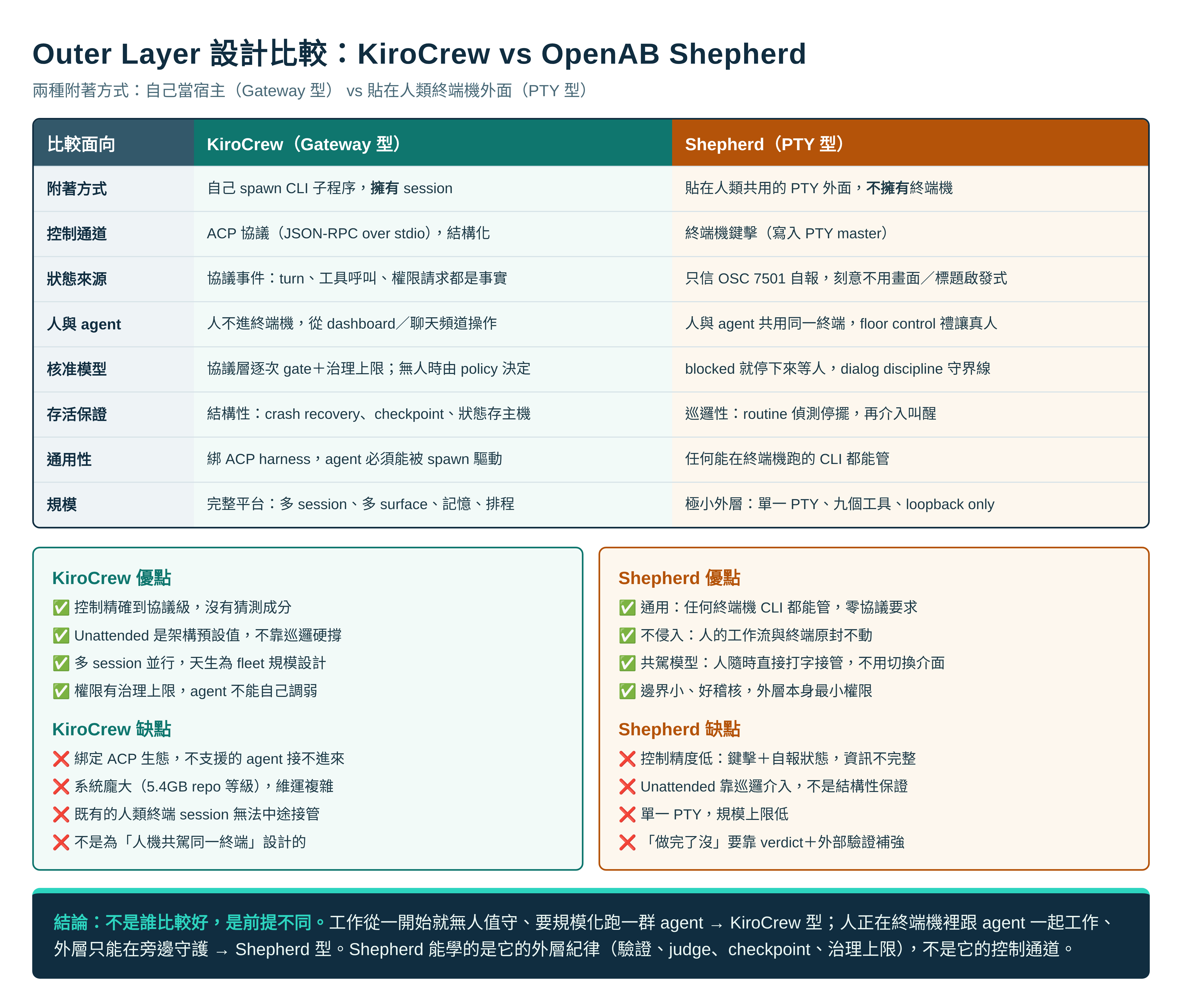
KiroCrew (Gateway-owned sessions) vs Shepherd (PTY-attached outer layer), side by side, including where each is stronger or weaker (diagram from the 2026-11-18 study; Chinese labels):
Activity
docs: add KiroCrew outer-layer study diagram (for openabdev#138)
docs: add KiroCrew vs Shepherd comparison table (for openabdev#138)