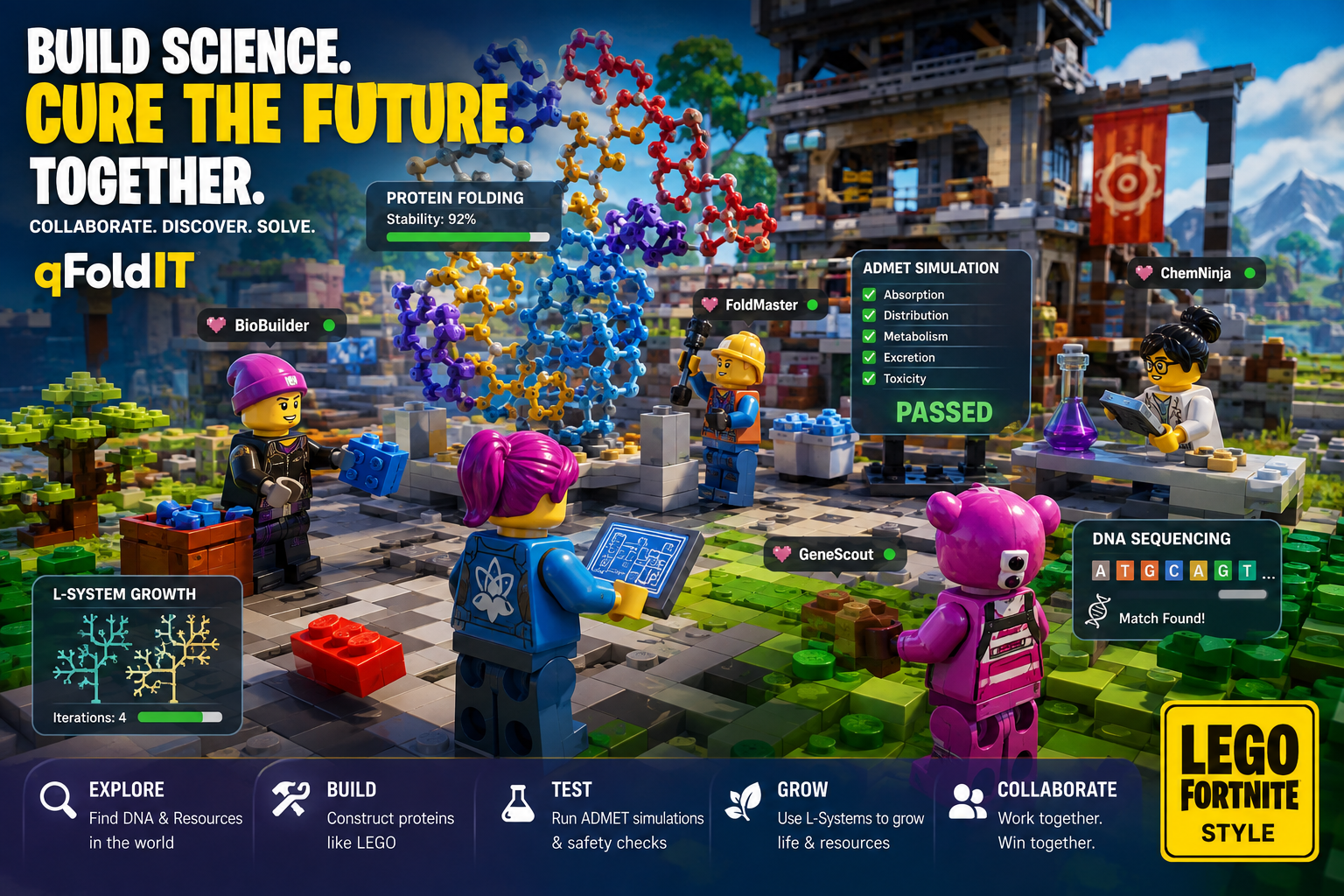
Turn scientific and industrial objectives into validated, interactive missions — through MCP, UAG, simulation and human-in-the-loop search.
GitHub · STATE · Dashboard · IP / Evidence Registry
qFoldIT is not only a game. It is a contract-first scientific mission platform connecting scientific computation, MCP-compatible AI agents, canonical spatial representations, multiple runtimes, validation and auditable contribution records.
Scientific / Industrial Objective
        ↓
Mission Contract
        ↓
Mission Router
        ↓
Mission Compiler
        ↓
UAG / Scientific Object Model
        ↓
UEFN / Unity / UNIGINE / Web / Standalone
        ↓
Human + AI Search
        ↓
CAMEO Reconciliation
        ↓
Scientific Validation
        ↓
Evidence / Contribution
        ↓
STATE / Enterprise Deliverable
qFoldIT exposes scientific capabilities through MCP-oriented services and canonical mission contracts. Claude and other compatible agents can orchestrate tools and compose missions, while authoritative scientific status remains with the configured scientific validators and protected reference boundaries.
Claude / Scientific Agent
        ↓
Scientific MCP Mesh
        ↓
qFoldIT Mission Contract
        ↓
UAG / Scientific Object Model
        ↓
Mission Compiler
        ↓
Runtime
        ↓
Scientific Validator
This separation prevents an LLM response, a game score or a visual representation from being mistaken for scientific evidence.
Scientific description → mission. Molecular, biological, materials, engineering and other structured targets can be expressed as governed missions.
Mission → UAG. The compiler produces a canonical spatial/interaction representation that is independent of a specific game engine.
UAG → runtime. qFoldIT adapters target UEFN/Fortnite, Unity, UNIGINE, Web, Standalone and virtual-laboratory surfaces.
Runtime → evidence. Player/agent/simulator submissions return through CAMEO-style reconciliation and authoritative scientific validation.
- Protein and peptide design
- Structural biology and molecular modeling
- Drug discovery and ADMET
- Synthetic biology and L-systems
- Materials and crystal discovery
- Batteries and advanced energy systems
- Semiconductors and AI hardware
- Quantum optimization
- Aerospace and space science
- Energy, hydrogen and carbon capture
- Mining and resource processing
- Industrial engineering and digital twins
qFoldIT's current OpenStructure integration provides a trusted server-side boundary for structure validation:
CORPORATE_APP
      ↓
qFoldIT OPENSTRUCTURE service
      ↓
OpenStructure / `ost`
      ↓
LDDT / local-LDDT / QS-score
      ↓
ValidationResult
Protected references stay on the trusted side. Scientific failures are fail-closed and are not turned into synthetic scores.
For interactive scientific runtimes, qFoldIT separates:
- Authoring — scientific target preparation and mission compilation.
- Runtime — player/agent interaction and event capture.
- Reconciliation — scientific validation, evidence creation and STATE projection.
This is particularly important for UEFN: the public architecture does not claim that Verse itself performs arbitrary live network calls to external scientific validators during a match.
qFoldIT optimizes for validated scientific contribution density, not simply for playtime.
Mission State + Player/Agent State + Historical Outcomes
                         ↓
                 Learning Policy
                         ↓
               Search / Coaching
                         ↓
                    Outcome
                         ↓
                  Validation
                         ↓
                    Evidence
                         ↓
                 Strategy Update
External engines and ecosystems are integration and distribution surfaces, not qFoldIT-owned infrastructure or IP.
| Surface | Role |
|---|---|
| Fortnite / UEFN | Multiplayer interactive runtime |
| Unity | General-purpose engine runtime |
| UNIGINE | High-fidelity simulation/runtime |
| Web | Browser-native 3D/physics runtime |
| Standalone | Desktop scientific interaction |
| Virtual Lab | Research, training and simulation |
The same scientific mission should be able to reach different audiences without rewriting the underlying scientific semantics.
qFoldIT retains its original interactive vision: scientific problems can become spatial, cooperative and competitive experiences.


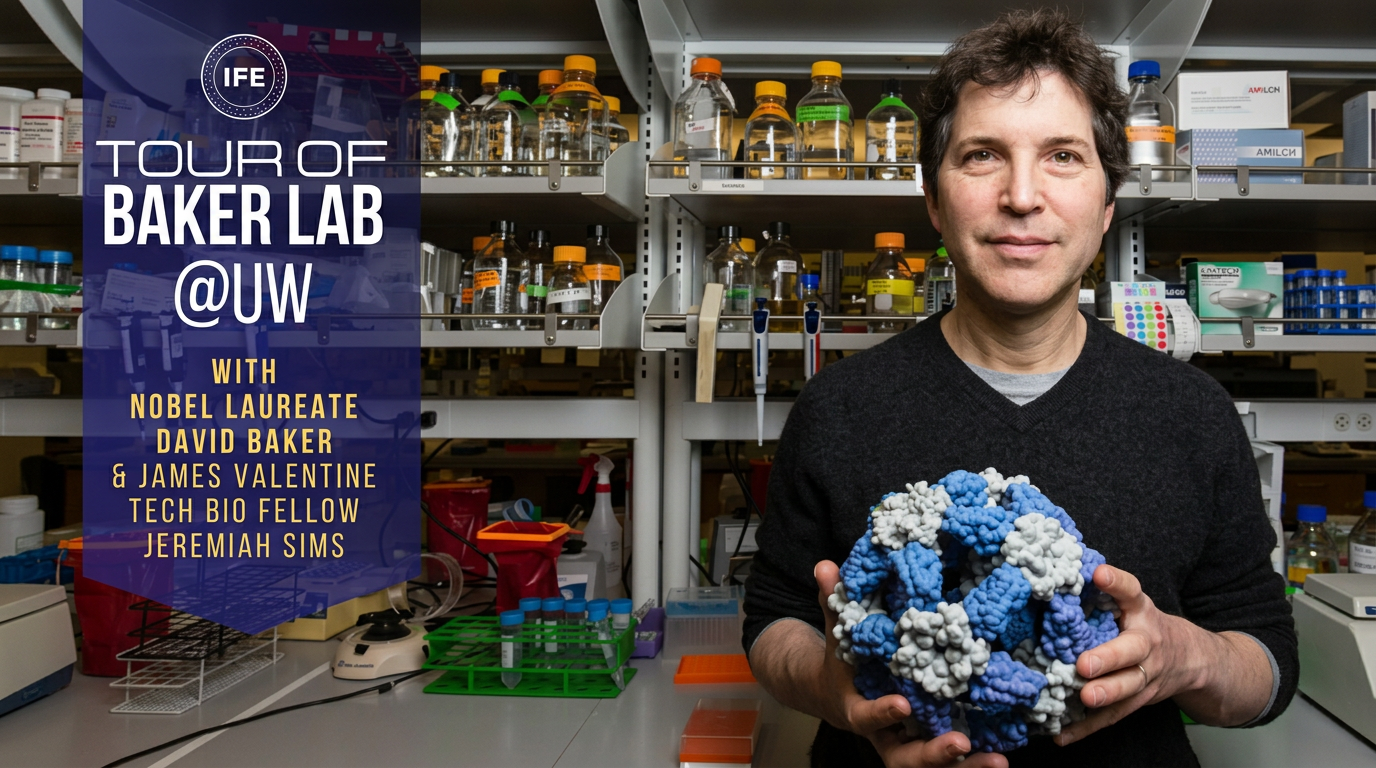
David Baker — Protein Folding Code
Kelly Chibale — Beyond the Code: AI 2050
Dr. Neil Voss — CryoEM & Protein Geometry
Silvia Holler — Future of folding
Alexei Lapkin — iDMT
Scientific publication — Playing Dice with the Universe
CAMEO — automated benchmarking
qFoldIT is designed to interoperate with open scientific ecosystems while preserving explicit provenance and licensing boundaries.
The current architecture acknowledges, among other upstream/reference systems, the Ersilia Open Source Initiative, FoldIT, OpenStructure, Virtual-Lab-Simulation and DropleX. Integration does not imply ownership of external source code, models, data, publications or trademarks.
The same mission architecture can support:
- corporate R&D campaigns;
- research institutions and universities;
- scientific software and simulation workflows;
- industrial optimization;
- government and public-sector science programs;
- citizen-science and educational deployments.
Private customer targets and protected ground truth remain inside authorized boundaries; the public site exposes only permitted STATE projections.
qFoldIT distinguishes implementation from possibility:
- E1 — verified implementation evidence;
- E2 — strong architecture/product evidence;
- E3 — design/roadmap/option evidence;
- EX — external/upstream evidence.
No third-party platform valuation, external benchmark, prospect list, playtime metric or roadmap claim is presented as qFoldIT revenue or owned IP.
- qFoldIT GitHub organization
- Public STATE
- Project dashboard
- CLI / mission prospects
- Canonical architecture
- IP / evidence registry
- FoldIT
- MCP
qFoldIT
qFoldIT@gmail.com
https://github.com/qfoldit
Sankofa: retrieve useful knowledge from the past and build forward.
Gye Nyame: except God, there are no limits.
The complete previous public README is preserved verbatim in README-LEGACY-2026-08-21.md, including the full historical image set, links, acknowledgements, partnership material, visual references and legacy roadmap language.